
“I have always loved it here. I have no wish to go away.”43
Tunnacliffe Flats (unofficial name, Invermere)
Tunnacliffe Flats is the long standing local name for the slightly raised bench in Invermere roughly around 4th Ave – north of the Eddie Mountain Memorial Arena and south of the old high school field (next to Service BC). But for all Tunnacliffe Flat firmly establishes the Tunnacliffe family in Invermere, the early history of the Tunnacliffes begins in Wilmer.
Edgar Elmer Tunnacliffe
The local Tunnacliffe patriarch was Edgar Elmer Tunnacliffe, born 30 March 1873 in Pelham, Welland, Ontario to parents John Tunnacliffe and Eliza Jane Moyres.1 He was the sixth of at least eight children, and spent his early years on the family farm. After his father passed away, in September 1889 when Edgar was age 16, Edgar continued to live with his mother and some of his siblings.2 Just over ten years later, in 1901 at age 28, Edgar was employed as a labourer in a nursery in Pelham.3
It’s a bit unclear when exactly Edgar moved west, although his death certificate suggests he came to British Columbia in 1901.4 An Edward Tunnacliffe is listed in the British Columbia Directory living in Vancouver in 1904, at which time he was a labourer working for M.J. Henry.5 Henry owned an extensive nursery, and this Edward once again appears in the local directory in 1908, this time as a nurseryman for the same employer.6
Chances are very high that this “Ed Tunnacliffe” was Edgar, given both that Edgar had worked in a nursery back in Ontario, and that the 1910 directory finally lists Edgar Tunnacliffe (as Edgar) as a nurseryman in Vancouver.7 (A newspaper article in May 1908 cites E Tunnacliffe as the manager of the city nurseries in Vancouver, but I could find no more about this.8)
Sometime around 1910, Edgar moved to Wilmer, appearing in local records for the first time in December 1910.9 An obituary at the time of his death suggests that he arrived as a nurseryman for Robert Randolph Bruce, who was the local manager for the Columbia Valley Irrigated Fruit Lands Co, and there is a record of Wilmer residents receiving fruit trees from Henry’s Nursery in Vancouver, where Tunnacliffe worked, in 1906.10
Minnie Thoms
The local Tunnacliffe matriarch was born Minnie Thoms in January 1881 in Germany to parents Wilhelm and Auguste. That same year the Thoms family moved to a farm just outside of Jamestown, North Dakota.11 Minnie’s mother, Auguste, passed away in September 1886 after a long illness, and her father Wilhelm remarried to a Caroline/Karoline (née unknown), who also arrived from Germany in 1881.12
In May 1900, Minnie was married in Stutsman, North Dakota to John Martin Joos,13 a school teacher born in Wisconsin in April 1867.14 The newlyweds lived just down the road from Minnie’s family on that year’s census. John Joos passed away in May 1909, leaving Minnie as a young widow.15 On the 1910 census, she was living in a household with Jacob B Joos (possibly her brother-in-law), as well as her younger sister, Martha.16
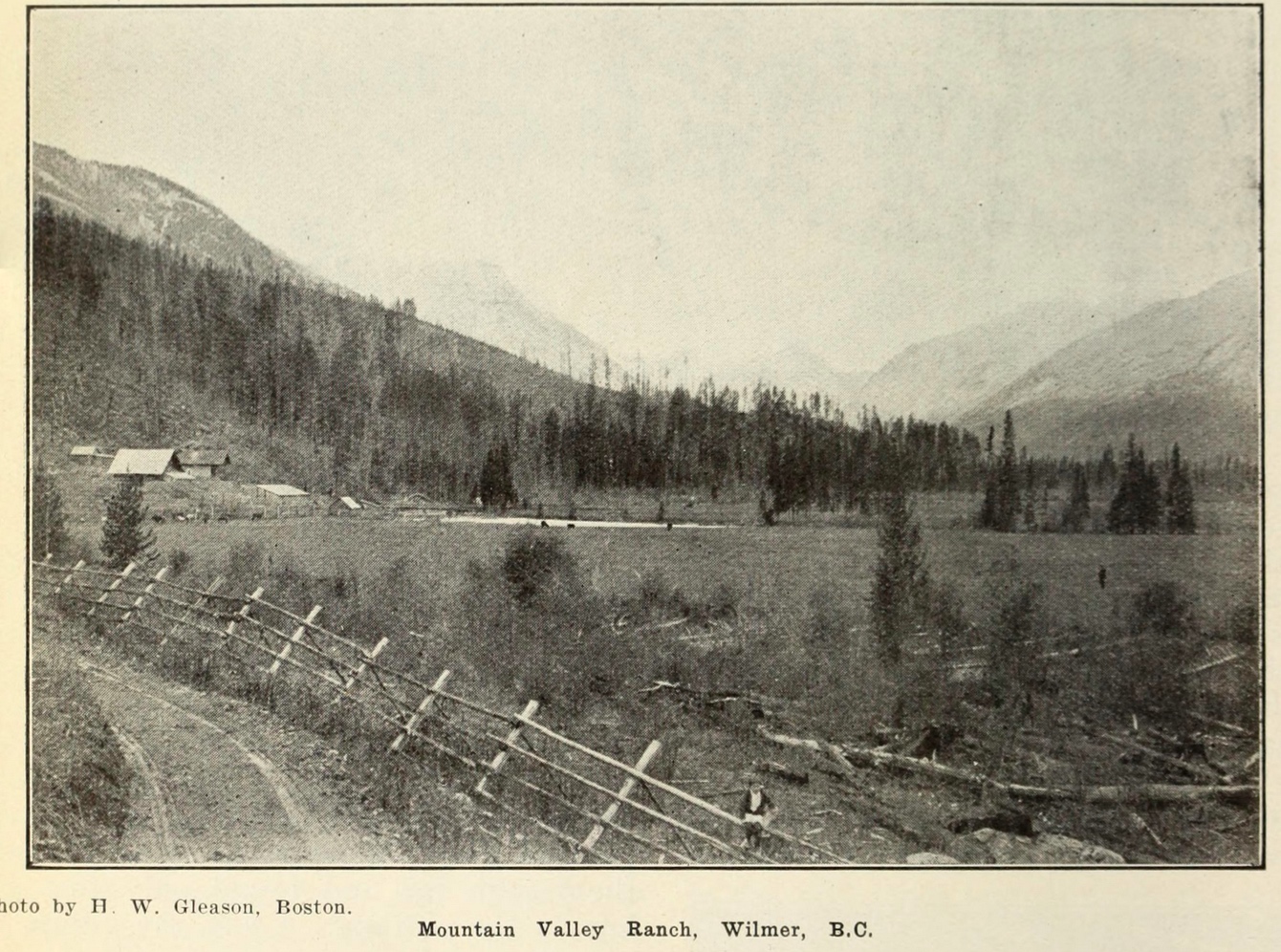
Likely in 1911, Minnie became friends with Elsie Starbird (née Lewis), who was visiting near Minnie’s North Dakota home. The two young women became friends, and Minnie accepted an invitation to live at the Starbird Ranch in the Windermere Valley. Minnie arrived in 1912 where, she later recalls, she “had a wonderful time. … There was riding, picnicking, and hunting trips to the hills when Mrs. Starbird and I would go along with Mr. Starbird and the visiting hunters. I was overwhelmed by the magnificent mountain scenery after the flat plains of North Dakota. I liked the people of the valley; their friendliness, their kindness and hospitality.”17
Wilmer Life
Living at the Starbird Ranch near Wilmer, Minnie soon met Edgar E Tunnacliffe. Although apparently brought to the area for his nursery experience, Edgar partnered with a __ Taylor to set up the Wilmer Agency Company, a real estate and insurance business. The partners were also the local agents for the owner of the Wilmer townsite.18

Edgar and Minnie Thoms/Joos quickly hit it off. It helped that they were both accomplished musicians, Minnie on the piano and Edgar on the fiddle. The couple returned to Jamestown, North Dakota in 1913, where on April 15 the two were married at the home of Mr and Mrs Thoms.19
Edgar was, at the time of their wedding, listed as a real estate and financial agent at Wilmer, although strangely Minnie later recalls that Edgar was hauling freight at the time they met (it’s not inconceivable that Edgar did such work, but I could not find evidence from the time that he worked as a labourer).20
The couple settled in Wilmer where, “they lived in a little frame house.” 21 Their son, Marvin, was born there in 1914, and his sister, Marion, follow in 1918. Minnie’s sister, Martha, also came from North Dakota after Marvin’s birth and stayed for five months. 22
Wilmer Community
The Tunnacliffes were very active in the Wilmer community. From the time of his arrival in Wilmer, Edgar became instrumental to the Windermere District Agricultural Society, initially as secretary,23 and was in 1911, “indefatigable in promoting the welfare of the forthcoming fall fair to be held at Athalmer.”24 This involvement with the Windermere Agricultural Association (later the Windermere District Farmers Institute) continued unbroken for the following quarter century until his resignation in 1935.25 Minnie was also, at times, a part of the Ladies Committee of the Farmers Institute/Fall Fair.26
Edgar was part of the founding executive committee of the Wilmer Curling Club as well, in 1911, along with the Wilmer Hockey Club at around the same time.27 He became one of the skips when the local curling club reformed in 1920 following the First World War, and remained as an executive of the club through into the 1940s, including as occasional president.28
Continuing his diverse interests, Edgar was elected president of the Windermere District Liberal Association in 1915, retaining that position the following year as well, and later carrying on as part of the executive committee.29 He sat on the first executive committee of the Windermere District Rod and Gun Club, in March 1919, and kept that position through the 1920s, becoming elected vice president and secretary treasurer in 1941.30
In addition, Edgar was at times on the executive of the Windermere District Board of Trade, the Windermere District Racing Association, and part of the Columbia Lodge of the Masons being, “honored with a lifelong membership in the Masonic Lodge,” in 1947.31
Minnie, meanwhile, was also a part of the Windermere District Branch of the Red Cross,32 and was very active in the United Church. One of the local circles for Trinity United Church Women was named “T & C” after Mrs Tunnacliffe and Mrs W.H. (Ethel) Cleland, long time friends from 1911 and “pioneer workers for the Ladies Aid.”33
The couple also played at local dances, along with third member Pat Kelly on fiddle.34
Sometime in 1916, Edgar became the district foreman for the Public Works, working on roads and streets of the community.35 He stayed in this position for twenty-eight years, retiring in May 1944.36 He also used his skills to supervise the community committee to turn what later became Kinsmen Beach into a public bathing beach and lakeshore park, in the late 1930s,37 as well as to supervise construction of Trinity United Church in Invermere in 1929.38
From Wilmer to Invermere
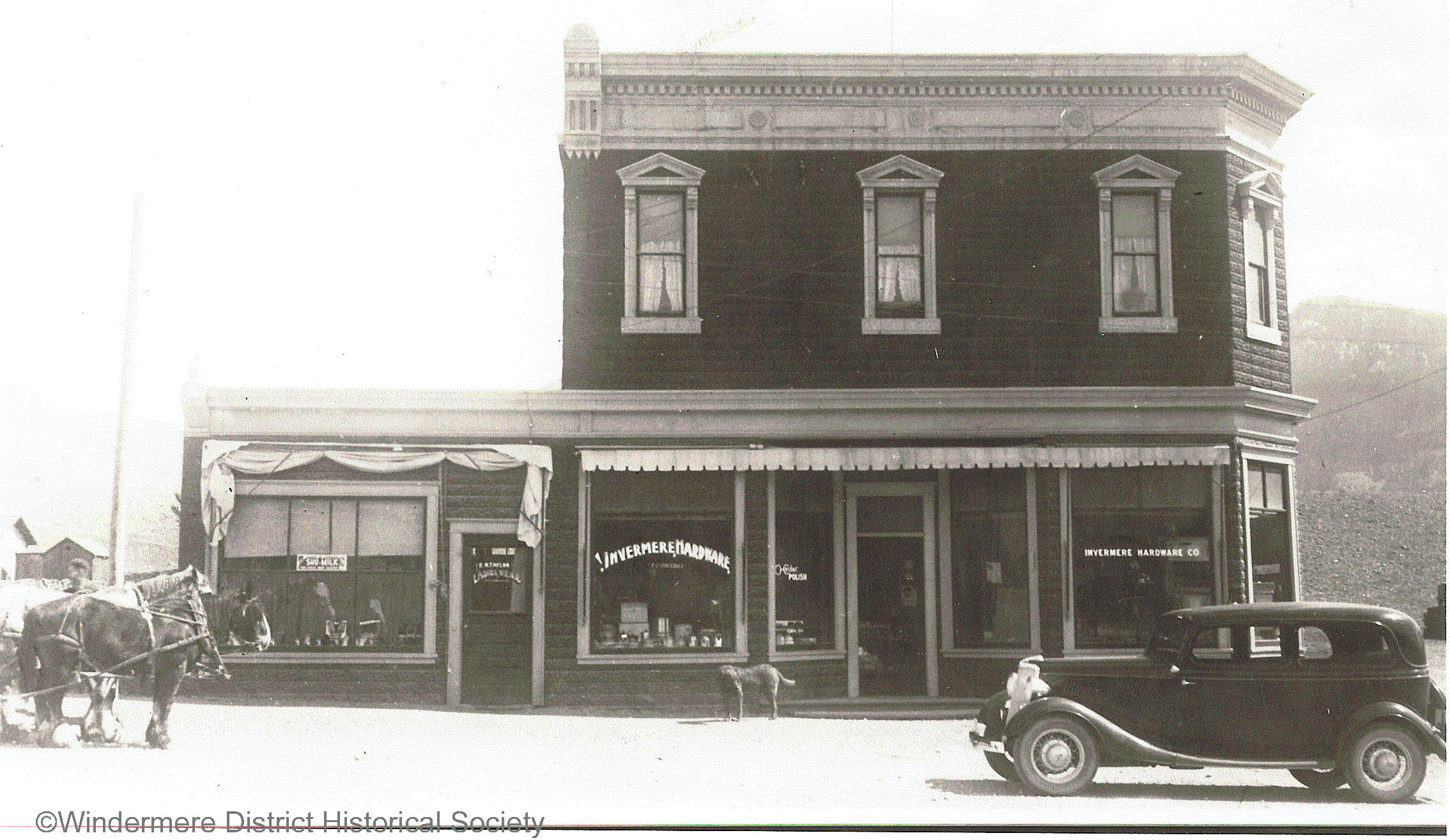
In 1929, the Tunnacliffe family made a significant move in location from Wilmer to “the big house on the hill” on the Esplanade in Invermere (now 4th Ave) overlooking Lake Windermere. The property had previously been occupied by Mr and Mrs George Allan Bennett,39 with Bennett having been the one-time manager of the Invermere Construction Company and a partner, along with Frank C Stockdale, in the Invermere Hardware.40
Edgar Elmer Tunnacliffe passed away on 27 January 1949 in Invermere. He was survived by his wife and son, along with two brothers and a sister in Ontario.41
After her husband’s death, “Mrs Tunny” remained in Invermere, giving room and board to a series of local women school teachers, “and each and every one of them became her lifelong friend.”42 In 1959 she shared with the local newspaper editor that, “she has no desire to leave the Valley. “I have always loved it here,” she says, “I have no wish to go away.”43 She passed away in Invermere on 8 December 1970 at age 89,44 at which time she was survived by her son, Marvin, two grandchildren, and six great grandchildren.45
Marvin Edgar Tunnacliffe
The eldest Tunnacliffe child was Marvin, born in 15 May 1914 in Wilmer. In his youth, Marvin took after his parents in his musical abilities, and in 1927 at age twelve he was “highly commended for his standing” in a musical competition open to children throughout the British Empire, being one of six to receive that designation.46 He became affectionately known as “Tunny”, and in later years would form a dance orchestra with the same name (Tunny’s).47
Marvin was married on 12 October 1935 in Wilmer to Ethel Thornton, who had previously worked for her father keeping the books at the Invermere Meat Market.48 The two settled in Invermere. In 1936 their home reportedly, “looks quite attractive as one approaches town from the opposite hill. [There is] An atmosphere of newness about it.”49 Marvin and Ethel had two children, Donald Edgar (Don) in 1936,50 and Ethel Carolyn (Lynn) in 1937.51
During the Second World War, Marvin graduated as a pilot from the Training School of the Royal Canadian Air Force in March 1943, and served in Quebec and Newfoundland as a Sergeant Pilot through the end of the conflict.52 Ethel and their kids joined Marvin in 1943 until Marvin’s discharge in September 1945. “Ethel never spoke much about these years except to say she was glad to be home.”53
Back in Invermere
Following the war, Marvin and Ethel lived with their family in a grey cottage across the road from the elder Tunnacliffe’s, and in 1948 they built a home on the same side of the street.54
Marvin was a member of the board of management for the newly constructed Windermere Memorial Community Centre (the replacement community hall for the David Thompson Memorial Fort).55 He also served as both president and secretary for the Canadian Legion Branch 71.56
Ethel, meanwhile, was very active in the Trinity United Church as well as various forms of fundraising entertainments (bake sales, theatricals, musicals, dances, balls, carnivals, picnics, sports days, curling, etc).57 She was also, reportedly, “an excellent seamstress” and also loved knitting.58

Windermere Valley Museum, C1886.
In other doings, Marvin, along with Charles E Osterloh, constructed the “Invermere Mercantile” building, which they sold in 1953 to Des Askey.59 In 1953 Tunnacliffe and Osterloh went into a business partnership, purchasing the Invermere Hardware from William and Joy Bond, who had themselves taken over the business from Frank C Stockdale in 1945.60 In 1959 they moved from the Hardware (now Village Arts) to a new building on 13th Ave, and went into building supplies.
Marvin went on to run for local office, becoming a village commissioner in about 1963, where he served as chairman of the works committee and oversaw the bylaw to green-light Paddy Ryan Lakes as the source of the Invermere water supply.61 In November 1965, Marvin became village chairman by acclamation, no one else having put their name forward for the position.62 Marvin reportedly served two terms, during which period the position of village chairman was changed to mayor, meaning that Marvin was also Invermere’s first mayor. His tenure included looking into leasing land on the Shuswap Reserve for a local airport,63 and extending a controversial subdivision on Canterbury Point (Fort Point).64
Marvin retired from council in November 1969,65 and from the hardware business in 1972. 66 He passed away on 23 April 1980 in Cranbrook.67 Marvin was remembered for his “fine sense of humour” and work for the community.68 A stained glass memorial window to Marvin’s memory was installed in the Trinity United Church in Invermere in 1980.
Ethel had worked alongside Marvin at the hardware. She passed away in Invermere on 19 January 1999.69 Of their children, Don remained living in Invermere, while Lynne and her husband John moved to the Coast.70
Marion Verna Tunnacliffe
The youngest of the Tunnacliffes, Marion, likely named after Edgar’s sister, was born 23 April 1918 in Invermere. Like her elder brother, she studied music with local instructor Dora K Bodecker,71 and was commended in 1930 at age 11 for her answer in a similar world wide open competition.72
Marion was later a teacher for Sunday School at the Invermere United Church,73 and left for Vancouver in January 1941 to attend a course at UBC.74 She worked at the Imperial Bank when she left school, until ill health forced her to give up the position.75
Unfortunately, Marion had developed diabetes at the age of nine, in 1927, at which time insulin injections to control the disease had not yet been invented. Minnie remained her caregiver. Marion suffered ill health for the rest of her life, frequently entering the hospital,76 and passing away in March 1945 at age twenty-six due to complications.77
Tunnacliffe Flats
The area now known locally as Tunnacliffe Flats, where the Tunnacliffe family had their home in Invermere, is also now very much a subdivision of Invermere. It’s located on the small rise north of the Eddie Mountain Memorial Arena, and south of the old high school field (by the fire station and BC Service).
The area was originally surveyed by the Columbia Valley Irrigated Fruitlands Co (CVIF) c.1911 as Divisions L and S of Lot 216. On these earlier maps, the flats was bounded on the east by the Esplanade (now 4th Ave) and on the west by Johnston Ave and Davidson Crescent (now 6th Ave) – (Johnston Ave being named after Edmund Johnston, and Davidson Crescent after original president of the CVIF C.H. Davidson Jr of Minneapolis, or James W Davidson, an original director).

O.A. McGuinness, Plan of Columbia Valley Irrigated Fruit Lands Limited. Invermere B.C. Lake Division Irrigation, Storage Reservoir and Domestic Water Systems, 15 December 1933. Map Collection, Windermere Valley Museum and Archives, Invermere B.C. [cropped]

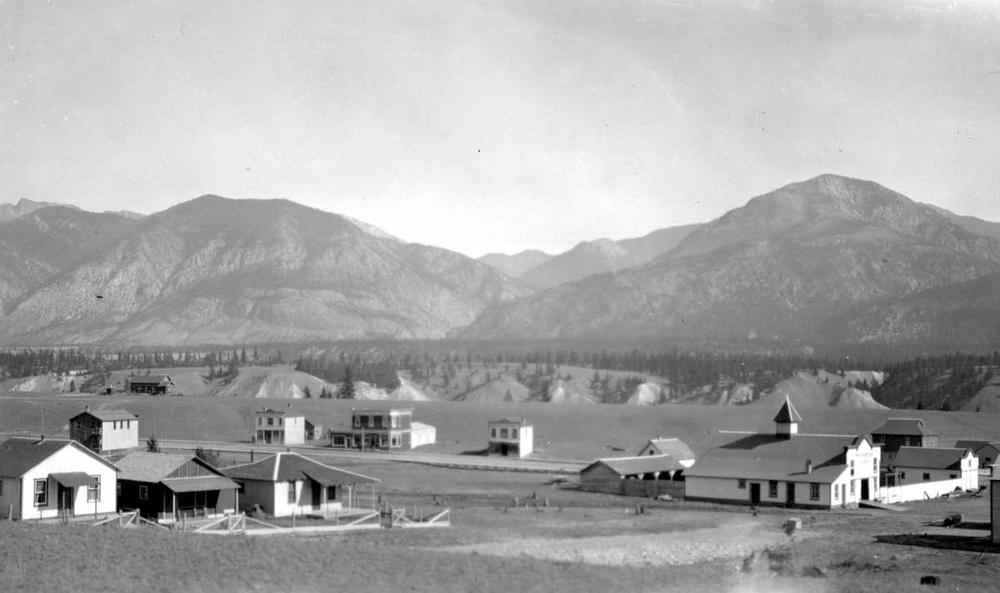
“Invermere,” [191-], NA-40197, BC Archives (Victoria B.C.).
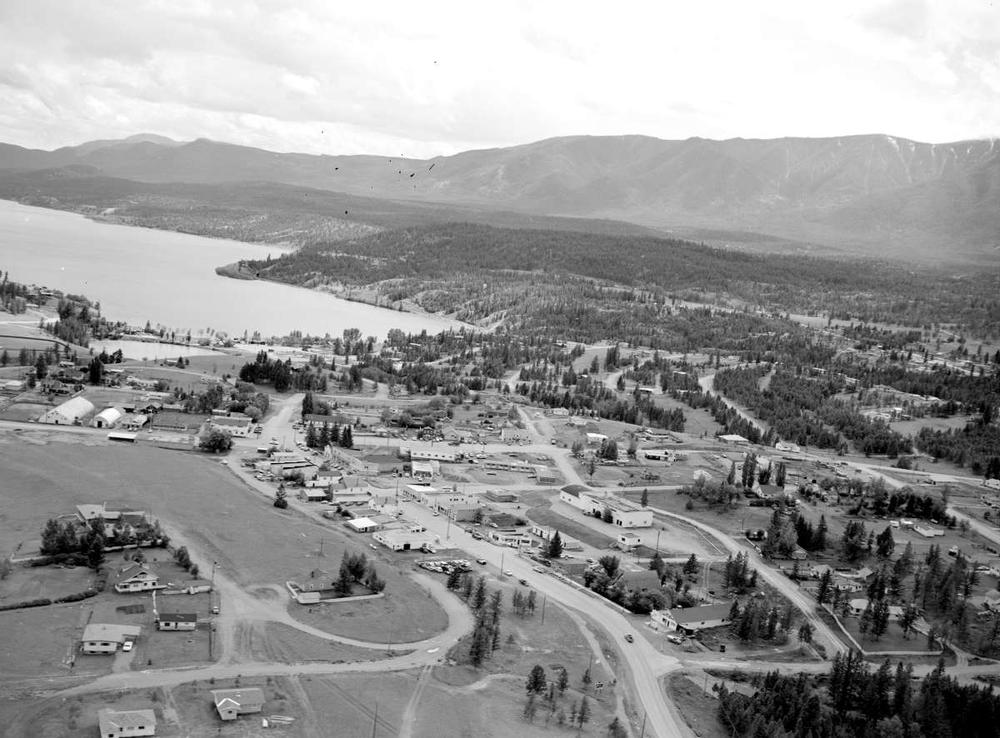
The name “Tunnacliffe Flats” seems to have come about in the 1940s or 1950s. By this time both the senior Tunnacliffes (Edgar and Minnie) as well as their son’s family (Marvin and Ethel) were living along the same street, and Marvin’s son Don would also build a home in the same area.78
Despite it being nowhere near official, the name seems to have survived amongst the locals. So if someone starts talking about Tunnacliffe Flats, now you know!
Leave a Reply