
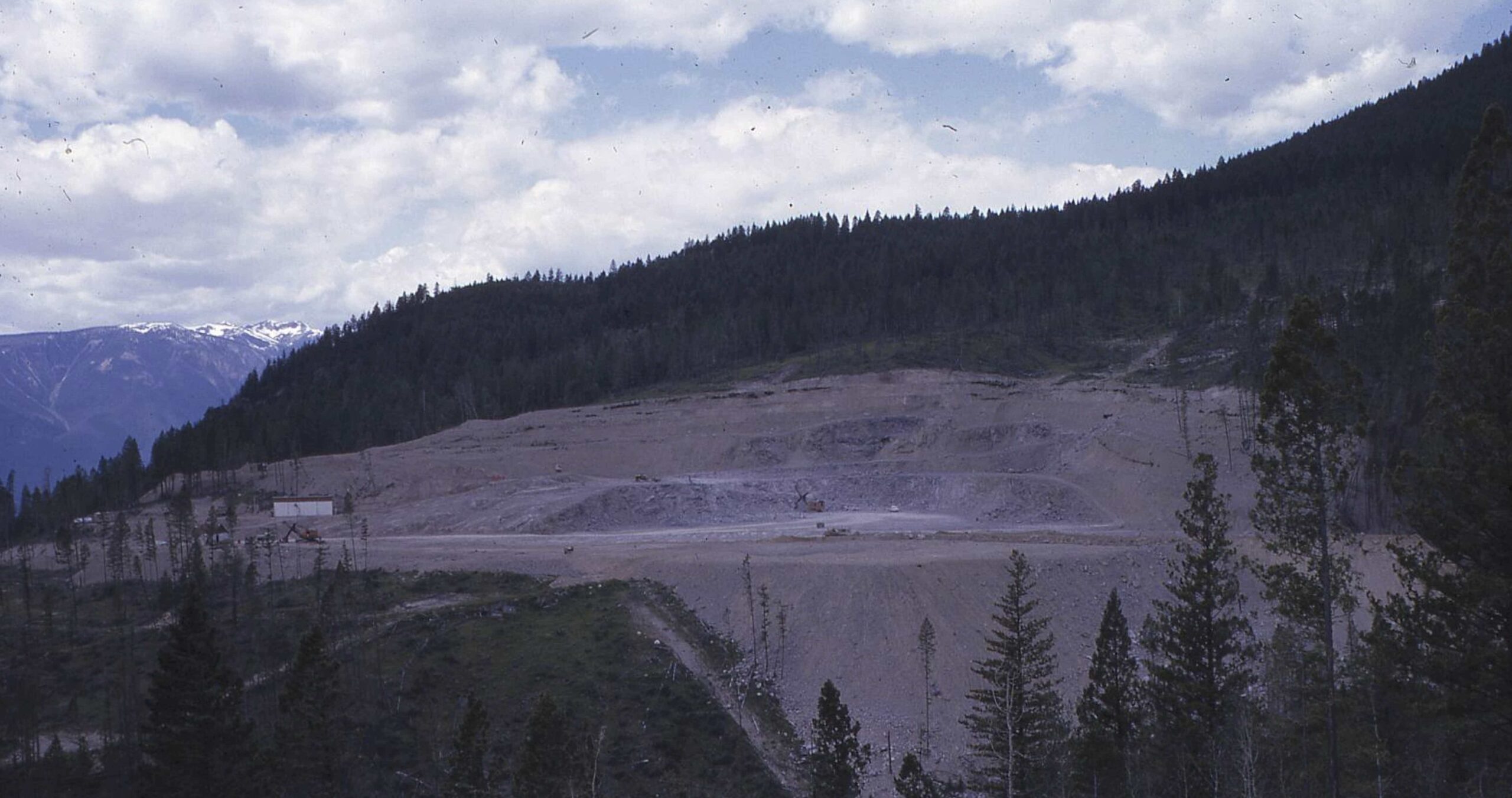
This was… “literally a mountain of pure gypsum which shows every indication of being one of the largest deposits in the West.”
Westroc Mine Road (Windermere)
The quarries of the gypsum mine located east of Windermere up Windermere Creek, typically called the Westroc Mine or the Gyprock Mine by locals, have been in more or less constant production since 1950, making this the longest continuously operating open pit mine operation in British Columbia.1 Millions of tonnes of gypsum from this mine have been used in the manufacture of drywall (wallboard or gyprock), as well as in cement production and as a soil additive for agricultural use.
Ownership of the mine has likewise been fairly steady, although it hasn’t technically been the “Westroc Mine” for a couple of decades now. Originally purchased in 1948 and owned by a couple of small companies (Columbia Gypsum of Spokane then Vancouver), it was sold in June 1957 to Western Gypsum Products Ltd, a subsidiary of British Plaster Board (BPB) Holdings Ltd of London.2 Another of BPB’s subsidiaries, Westroc Industries Ltd, took over operation of the Windermere quarries in 1976.3 The unofficial name for the mine and the official name for the haul road (the Westroc Mine Road) came from this period of Westroc’s ownership, which lasted until 2003.
In 2003 the property was taken over directly by BPB Canada Inc. BPB Holdings was acquired in 2005 by the French multinational corporation Saint-Gobain, which specializes in building and construction materials,4 and two years later, in 2007, the Saint-Gobain’s subsidiary CertainTeed took over the gypsum mine.5 CertainTeed remains the owner of the property today.6
Table of Contents
The Legend of Discovery
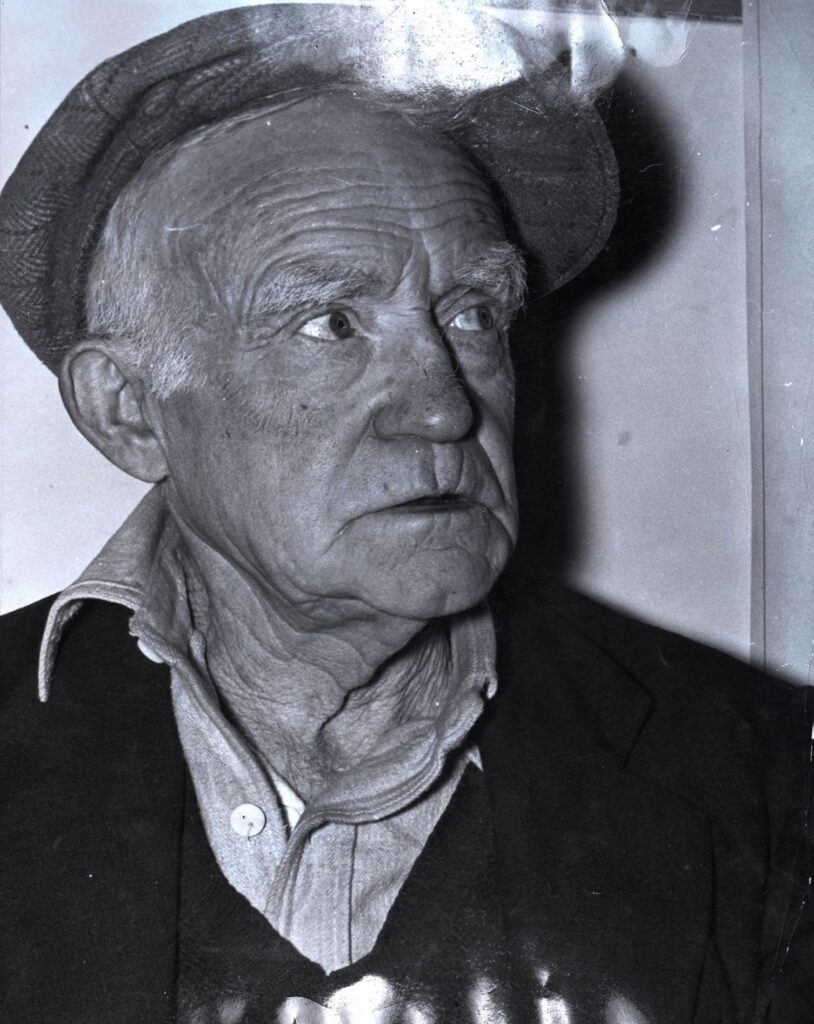
There’s a bit of a legend when it comes to the origins of the gypsum mine. As the story goes, in about 1923 Windermere resident Ernest Edward Bryan was on his trapline just off the trail up Windermere Creek when he came to a steep slope in the ground, and decided to cut down and up the other side rather than go the long way around. He was nearly at the top again when a bush he grabbed gave way. He fell down to the bottom again, and “It was then that he saw the rock of gypsum, a great slab of it standing 30 feet [9 meters] high, covered with moss.”7 He scraped off a sample of the rock, covered the cut with moss again, and blazed a tree so that he might find the place again.
According to this story, Bryan’s rock sample was set off to Ottawa, “and the report came back that it was the purest gypsum known in Canada,” but that no more attention was paid to it as demand for gypsum at the time was low, and remained low until after the Second World War.8 It was only then, in 1947, that seventy-year old Ernie Bryan returned to the area to renew his gypsum quest. He knew it was there, but never did find that original outcrop: instead, while resting from climbing up a hill, Ernie watched a colony of ants weaving in and out of the ground and tunneling up the distinctive white powder of gypsum. And that, according to legend, is how the gypsum deposit finally came to light.9
The Actual Discovery
Naturally, a closer look at the written record suggests that the discovery and staking of the original gypsum claims was a bit more complicated than this. For one, there’s the matter of attributing the discovery to those who made it. All records agree that Ernie Bryan should get the credit, but an obituary for Jimmy Neass of the Kootenay Reserve also notes, intriguingly, that Jimmy, “is said to be one of the first to have recognized the great gypsum deposits” in the Windermere Creek area.10 Unfortunately there is no elaboration as to Jimmy’s exact role in this.
The supposed lack of demand for gypsum before the war also isn’t a convincing explanation as to why the Windermere deposits remained undeveloped for so long after the initial discovery in the early 1920s. While it is true that there was a general post-war depression in Canada that extended into the building industry, by 1926 the economy had improved and gypsum had a market. That year, a gypsum property began production in Falkland (near Kamloops), shipping material to New Westminster primarily for plaster of Paris and plaster-board (drywall).11 A second gypsum property, located east of Cranbrook about midway to Wardner (near Mayook Siding), also began limited production in 1926, with the Canada Cement Company shipping material to the cement works at Exshaw, Alberta.12
The written record also shares slightly more detail about how the original claims were staked in June/July 1947. Ernie Bryan wasn’t out there as the lone prospector, but rather was accompanied by two others: E.C. Phillips and Thomas Cameron. Phillips was the owner of the nearby Elkhorn Ranch, and Thomas Cameron was a guest there. Cameron had also previously had a farm east of Cranbrook at Mayook: it was on his family farm that gypsum had been discovered in 1926.13
Cameron’s earlier experience with gypsum and gypsum mining gave him somewhat unique knowledge about what gypsum looked like and it might be marketed. One might imagine a conversation between Phillips (the proprietor of Elkhorn Ranch) and Cameron (who was visiting as a guest): Cameron might mention off hand his involvement in a gypsum property, and Phillips might respond with interest and share that, according to the local grapevine, Ernie Bryan had found a deposit of the stuff.14 We don’t know exactly how events took place but we do know that, in late June 1947, the three – Bryan, Phillips, and Cameron – went to investigate the hillside on the north side of Windermere Creek. Within the week they had staked five claims.15
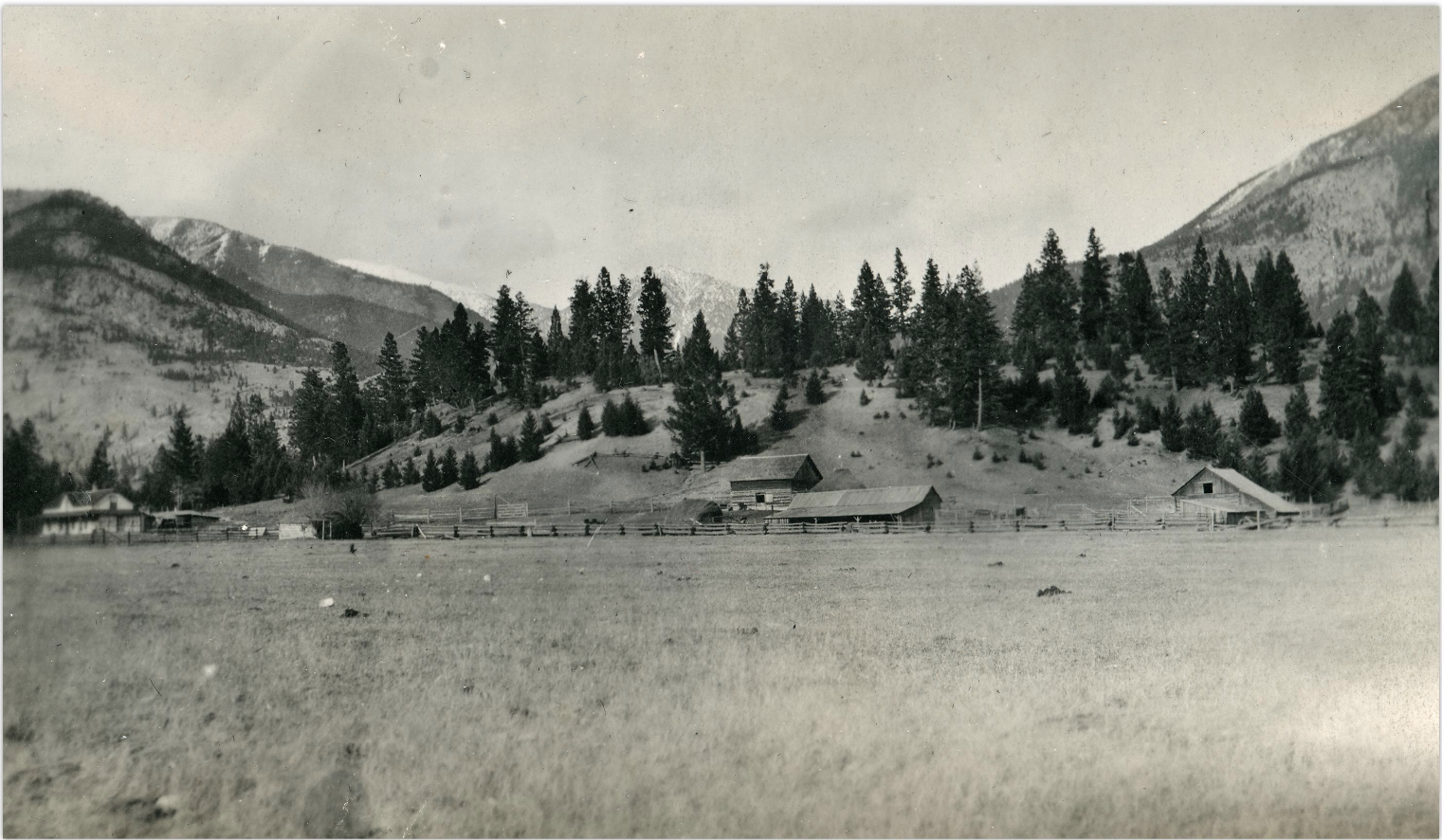
“Big House Ranch in Windermere,” n.d. A1243, Windermere Valley Museum and Archives.
Early Claims
For some unexplained reason there was a trend in the names of the initial gypsum claims being “Blue”, and so the first five claims were named the Blue Bird, Blue Jay, Blue Grouse, Blue Hawk, and Blue Goose. The map at the top of the page colours these five original claims, located on the north side of Windermere Creek, in orange. On the modern landscape, these were along the road that continues straight just before the main haul road crosses a bridge towards the Windermere Wells Recreation Site. Readers might be more familiar with this as being along the access road to Pinto Mountain.
The access/haul road between the main highway and the mine site was surveyed and constructed in the summer of 1948,16 in part with a grant in aid from the province to help finance this work.17
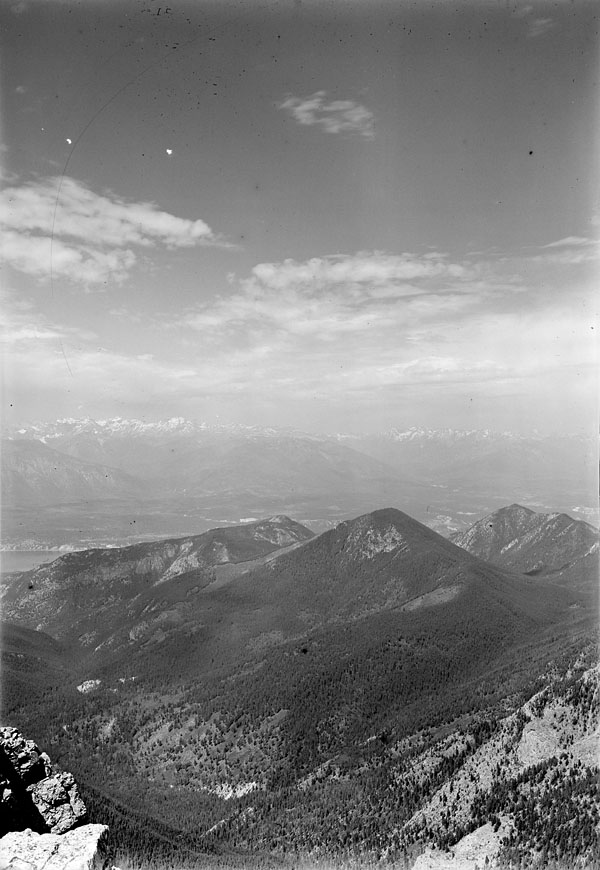
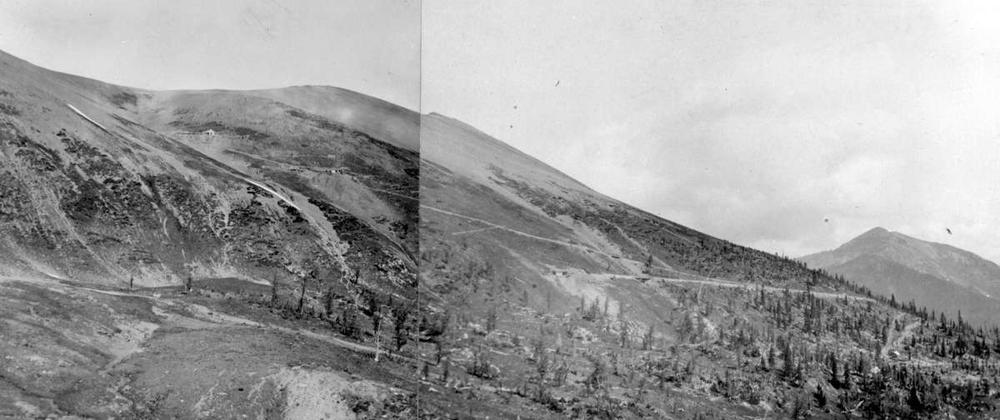
“West view at Station 103, looking down Windermere creek,” 1923, M.P. Bridgland, Geodetic Survey of Canada, e008072419, Library and Archives Canada.
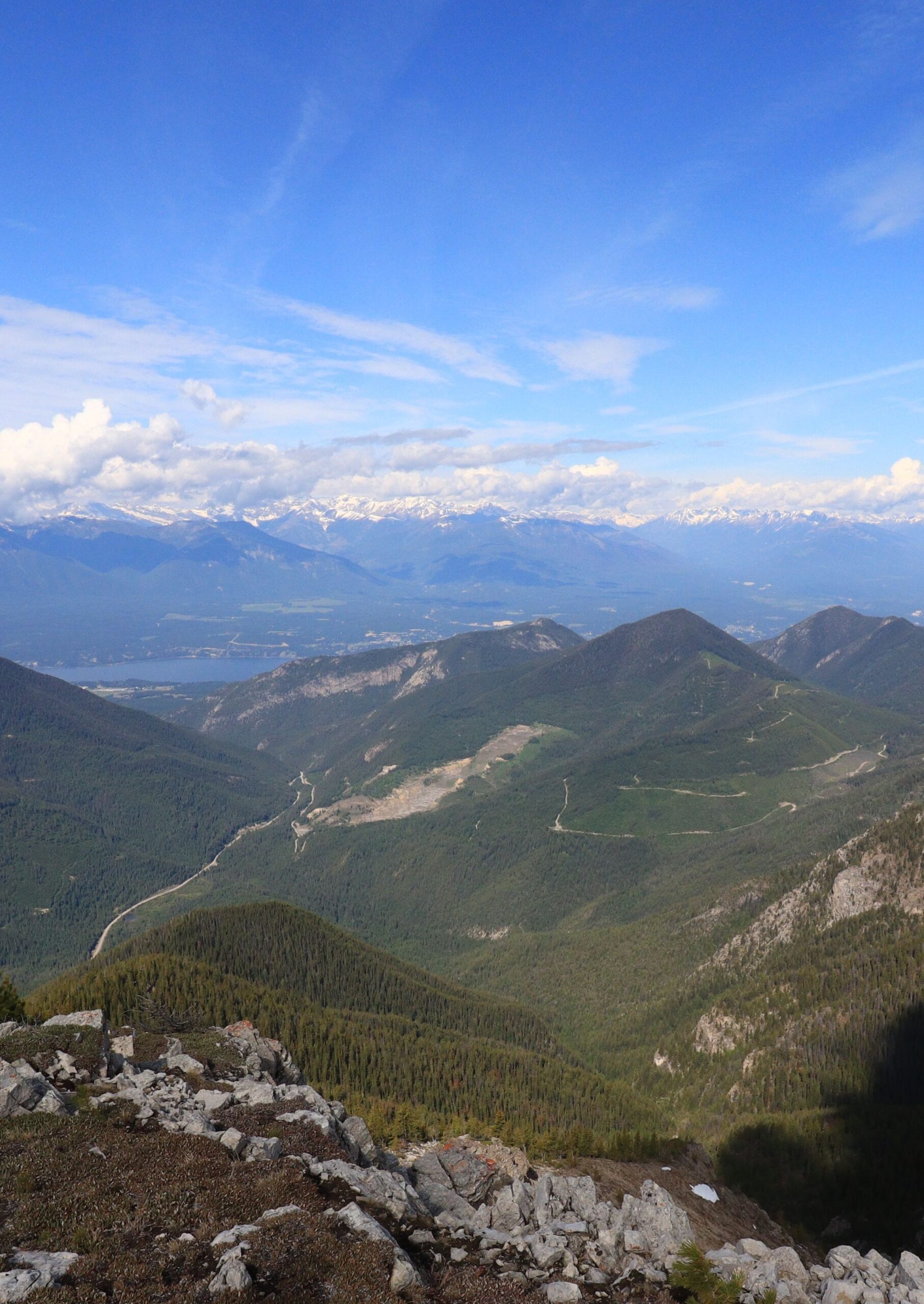
Windermere Creek from Mount Bryan, June 2024
The province conducted tests on samples from these original claims in the summer of 1947 which suggested that they, “may yield the purest gypsum in Canada.”18 To give some idea, deposits were said to range from 90 to 94% gypsum (more recent quarries have ranged closer to 80%).19
At this time, gypsum was of growing importance to the building industry. High quality gypsum is used in the production of drywall (also known as wallboard or gyprock), although historically it was also used in plaster. Lower quality gypsum is used as an additive in cement manufacture, and also in the agricultural field as a soil additive. With the population and building boom in post-war Canada, demand for both drywall and cement was growing, and the agricultural market was likewise strong.
Columbia Gypsum Products
Attracted by these prospects, the Windermere Creek properties were sold in early 1948 to a newly created company, Columbia Gypsums Ltd (later Columbia Gypsum Products Inc), which was incorporated in the State of Washington to develop the property.20 E.C. Phillips remained associated with the mine as a director for the company, and both Bryan and Cameron were shareholders.21
Work began immediately in Spokane, Washington to build a plant to process the Windermere gypsum, which was to be used to produce agricultural gypsum (a soil additive), as well as in building products (drywall and plaster).22 In time, the Spokane plant ended up being used primarily for agricultural products.23
The spring/summer of 1948 saw a large amount of prospecting work done up the Windermere Creek valley by Columbia Gypsum. The gypsum deposits weren’t obvious at first glance. The hillside up Windermere Creek was heavily covered with glacial till and limestone, never mind the trees and other vegetation. Natural outcroppings of rock were rare, meaning that gypsum tended not to be directly visible.
Instead, locating gypsum required the use of natural aids including sinkholes, slides, and a particular and peculiar kind of limestone conglomerate that was found to cover large gypsum deposits in this area.24 The sinkholes, which ranged from a few feet to several hundred feet in diameter (nearly 100 meters), and from a foot to over a hundred feet (30 meters) in depth, formed, “a striking feature in the topography,” and were found to be a very reliable indicator of the presence of gypsum.25 It is likely one of these large sinkholes that Ernie Bryan had taken a short-cut through two dozen years before.
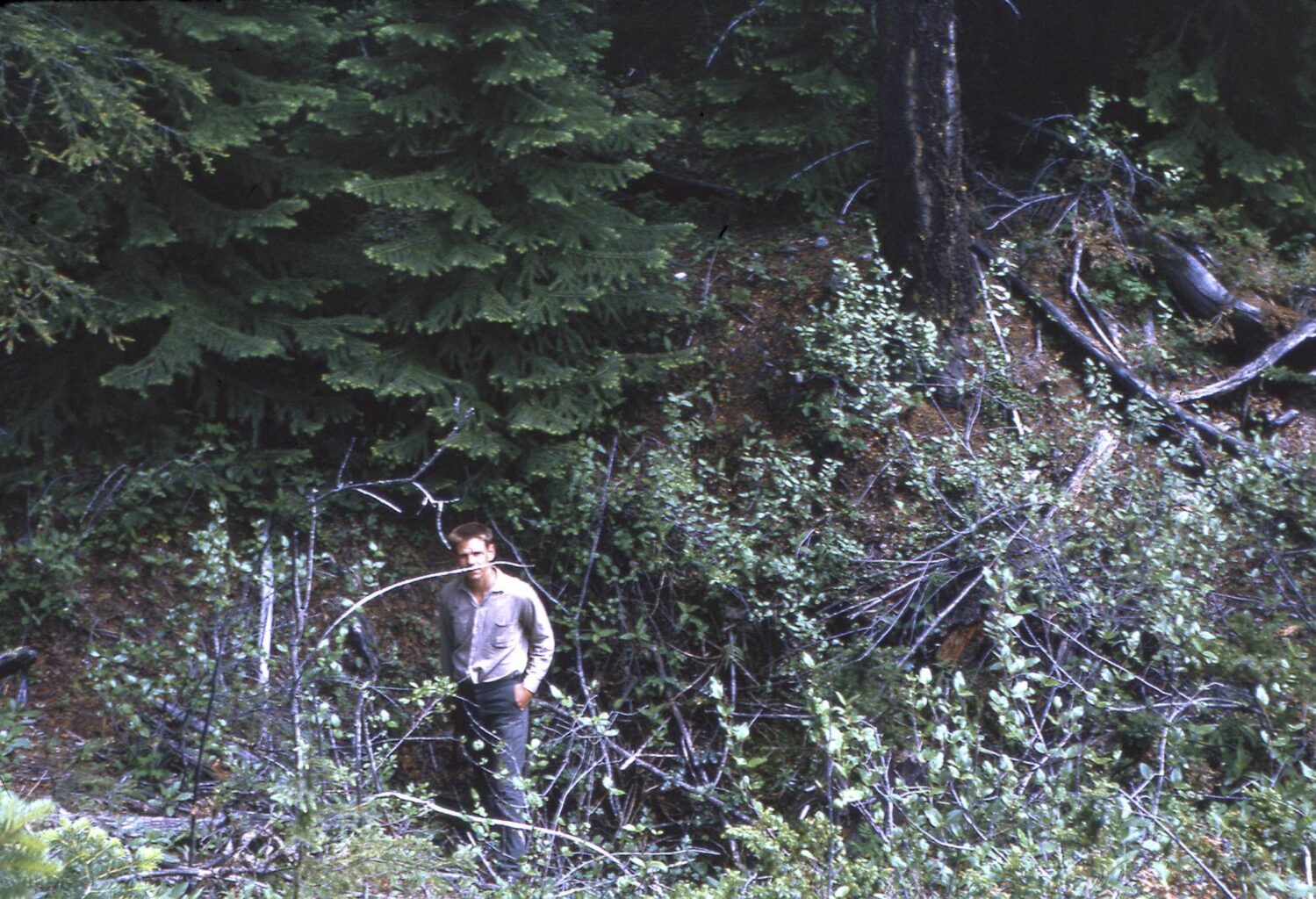
“Sink hole in Gypsum – 51MC62,” 1 July 1962, Columbia Gypsum, Dick Player File, British Columbia Property File PF507026.
After a season of thorough prospecting, a corridor of fourteen additional properties were located to the north of and above the original five claims, extending 1.5 miles (2.5 kilometers) up the ridge. These claims staked in 1948 are coloured yellow on the map at the top of this post.
This was, according to the company, “literally a mountain of pure gypsum which shows every indication of being one of the largest deposits in the West.”26 Conservative estimates placed the deposit at over a million tons, which made the Windermere Creek deposits the third largest known gypsum deposit in North America.27 Later estimates were even more promising, and these deposits became the primary gypsum deposit in western Canada. Further prospecting the following summer (1949) added seventeen more claims (coloured purple on the above map), extending the group north towards Shuswap Creek.28
A separate group of claims was also staked in 1948 about 3.5 kilometers south of the original group (further up Windermere Creek). The first of these was the Elkhorn, staked in May, and named after the Phillips’ Elkhorn Guest Ranch. This would become the basis for the Elkhorn Group, which is the ‘modern’ gypsum mine, and the one that most residents will be the most familiar with. Later that summer the Elkhorn was joined by three additional claims adjacent to it: these returned to the ‘blue’ trend (though they seem to have run out of birds) with the Blue Shirt, the Blueberry, and the Blue Bottle.29
Mining Begins
Work up Windermere Creek continued through 1949 to develop a quarry at the site of the original claims. A loading platform was completed and a quarry face was cleared, but operations could not begin until the Spokane plant was completed and shipping infrastructure was ready.30 A 1,900 foot (580 meter) siding, loading ramp, and a ‘Y’ in the railway tracks were also constructed down near the Lake Windermere Station in Athalmer: in these early years, gypsum was shipped primarily by rail.31
Sporadic production in the quarry finally began in spring 1950 with the first shipment leaving for Spokane at the end of April.32 There were delays in processing this material into a saleable product, however, as a large amount of snow had got into the raw rock, and it was necessary to dry out the material before anything could be done with it.33 Shipping and processing wet gypsum remained a problem for decades, and continues to be so today: gypsum tends to solidify when wet, making it very difficult to get out of rail cars, especially after days of vibration has packed it down.34
Production at the mine remained intermittent until September 1950 after which more regular shipments were made.35 This delay in production was in part due to having to shift the quarry slightly further up the hill after irregular masses of clay were found scattered through the gypsum at the original workings (see section “Quarries” below).36 Until early 1954, on-the-ground operations were under resident manager John M. Cummings, who was formerly a specialist in industrial minerals with the BC Department of Mines.37
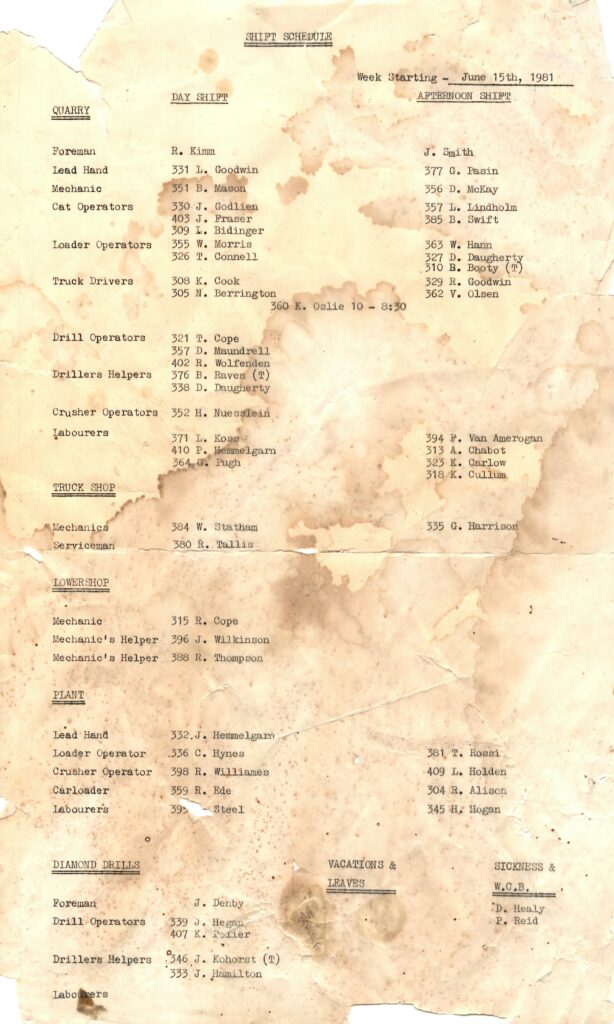
Operations through the years have regularly employed between 10 and 30 people: in some years the quarry has only operated for part of the year. Aside from seasonal and operational variations, employment was remarkably steady: working at the mine was a well-paid job, and Jerry Kohorst, who worked at the mine between 1977 and 2015, recalls that very few people quit.38 If you’re interested, you may find some familiar names on a shift schedule from June 1981 below: thanks to Jerry Kohorst for sharing this!
Westroc Mine Shift Schedule, week of June 15th, 1981.
This was a busy week (and summer) at the mine: this is about the maximum number of people employed. In addition to regular operations at the Windermere Creek quarry, exploratory drilling was also being undertaken at the Elkhorn Group.
Mining Methods
The exact equipment used at the gypsum quarry varied somewhat during the years, but the basic principle remained the same. Gypsum was removed from the quarry by drilling into the rock and loading the holes with explosives. After the rock was blasted down, it was picked up by shovel and transported by shuttle truck to the crushing and screening plant. This plant produced crushed and separated material according to size – anywhere from 8 inch (20 cm) diameter down to powder.
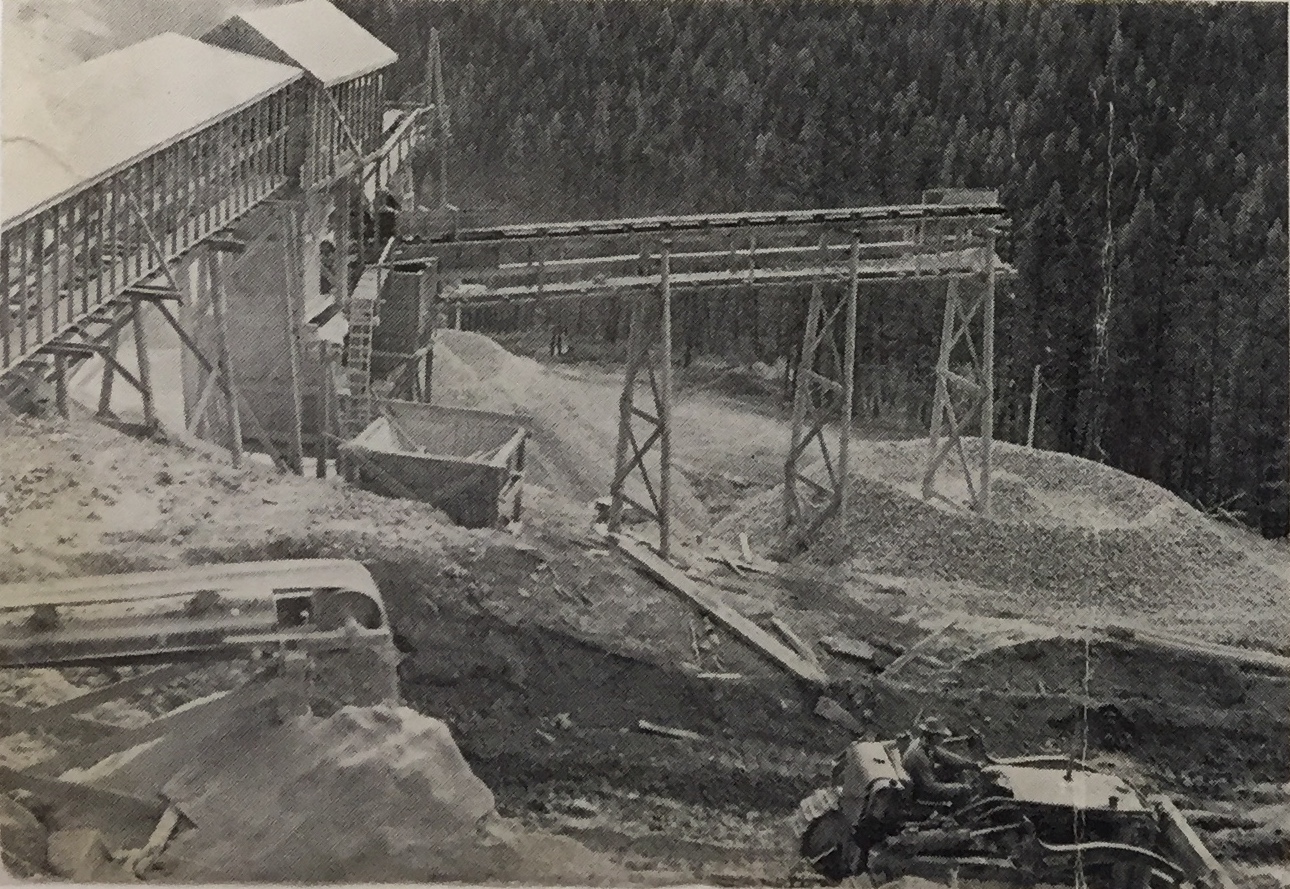
J.M. Cummings, Columbia Gypsum Products, Inc, “The Windermere Gypsum Deposit,” Western Miner and Oil Review, Vancouver, November 1953. In WVM Box G, File Gypsum mine.
There was some variation to this method. The early quarry was incredibly steep, with workers rappelling on ropes down the face to drill into the rock. In 1958, shortly after the mine was sold to Western Gypsum Products Ltd (in 1957), a new quarry was opened and gypsum began to be blasted out in wider “benches”. While the face of the quarries was still steep, it wasn’t nearly as high, and didn’t require the high-rope acrobatic drilling from earlier years!
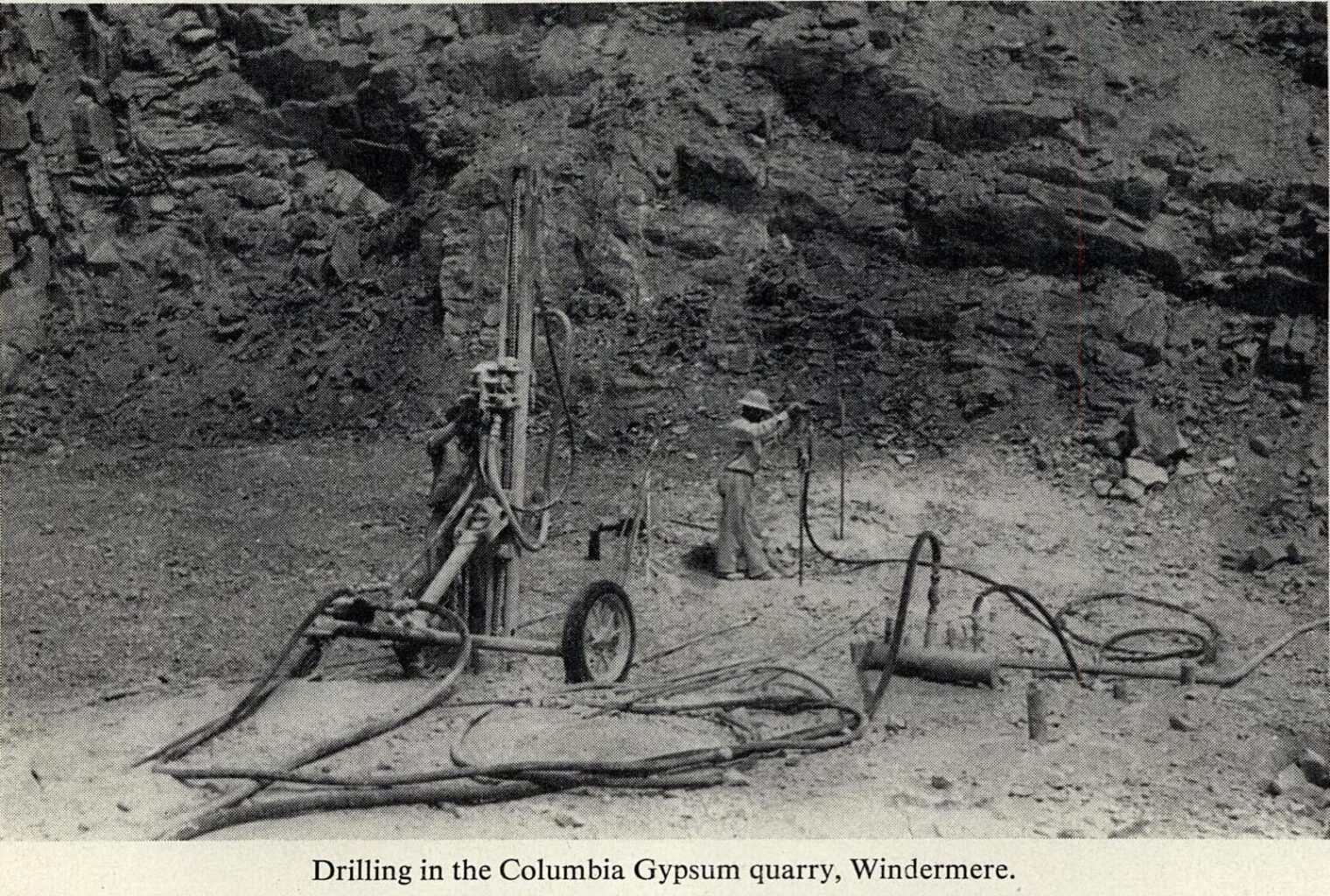
Crushing the rock, meanwhile, also varied somewhat over time. When operations began, this processing was done up at the quarry itself, with trucks being loaded to haul the processed rock to the railway siding at Athalmer where it was weighed and dumped into rail cars.
This activity shifted in 1960 when the crushing plant was moved to a new mill-site located adjacent to the railway on the Shuswap Reserve. Gypsum was trucked directly to the site (via a newly built private road) where it was crushed and loaded onto the train.39
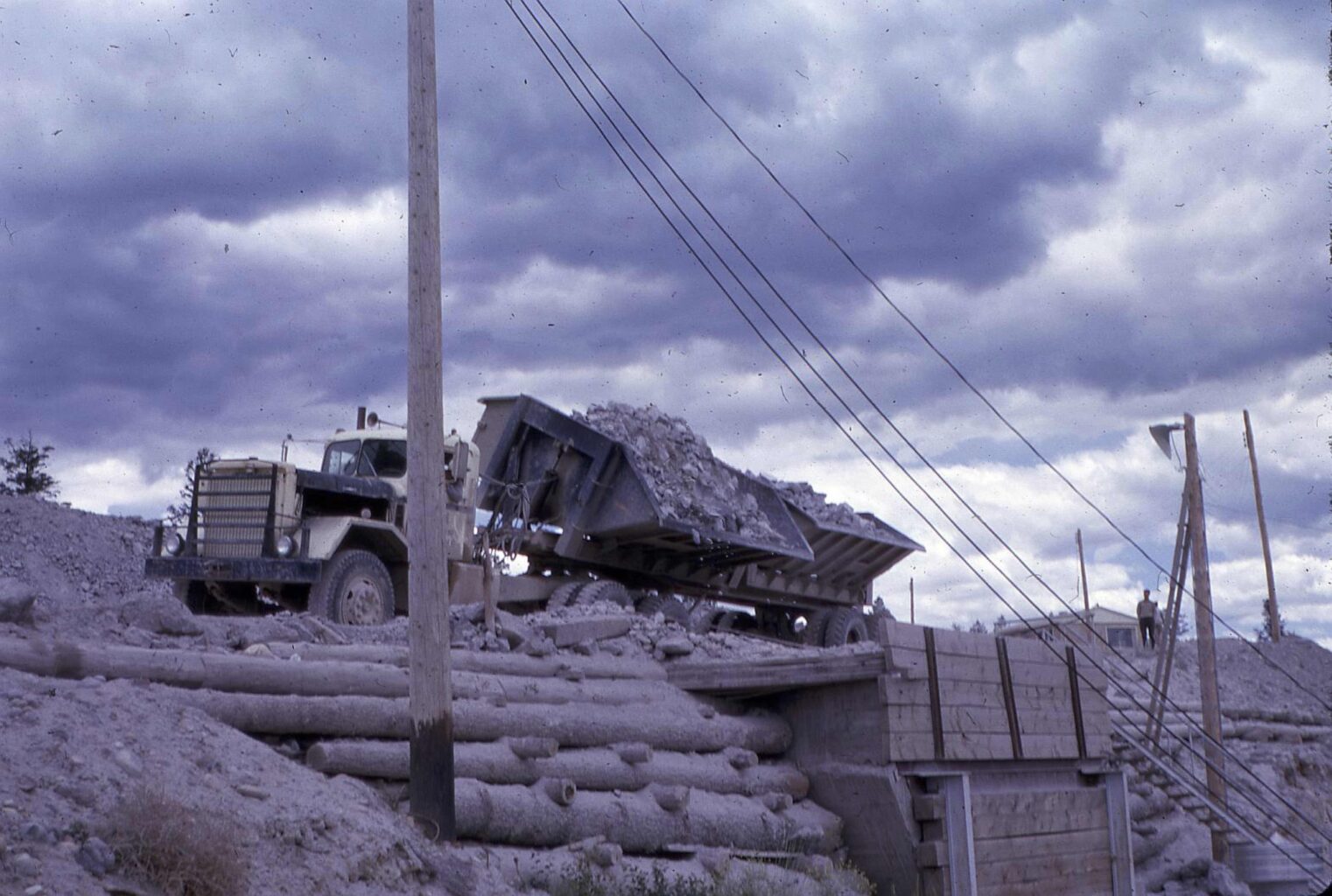
“Unloading Gypsum – 50MC62,” July 1962, Dick Player File, 507025, Property File, British Columbia.
A primary crushing plant was re-introduced to the quarry in 1966, allowing fine gypsum to be stockpiled there while the coarse material was brought to the main crusher by the railway.40 Use of the railway crushing plant and loading station on the Reserve ended suddenly in the 1980s, around the same time as the shift in operations to the Elkhorn Quarry. After this, both the primary and secondary crushers were at the mine site, and gypsum was once again loaded onto trains in Athalmer (adjacent to the Max Helmer Construction yards).41 Note that, over time, stockpiles of crushed gypsum were stored at the mine and near the rail yard as insurance against bad weather and spring break-up.42
In early decades, shipments were made exclusively by rail. In addition to shipments made down to the plant in Spokane (this became the Greenacres Gypsum plant), the Windermere quarries also supplied drywall plants near Vancouver and in Calgary, and continued to do so for decades.43 Cement plants were also regular purchasers of Windermere gypsum, including a plant in Edmonton (Inland Cement) as well as Exshaw. In 1995, some product was also shipped to an agricultural plant at Rocky Mountain House.44
According to long-time mine employee Jerry Kohorst, Windermere gypsum was supplied consistently to pretty much the same clients year after year. The priority was to supply gypsum to company-owned drywall plants in Vancouver and Calgary, but demand was strong from other purchasers in as well, notably in the cement industry. A large cost of production is shipping, and if plants couldn’t get their gypsum from Windermere – the one consistent course for gypsum in Western Canada – they would have to bring it in from other suppliers in Manitoba or elsewhere in Canada/Mexico. Windermere gypsum was understandably preferred.
Trends in Production
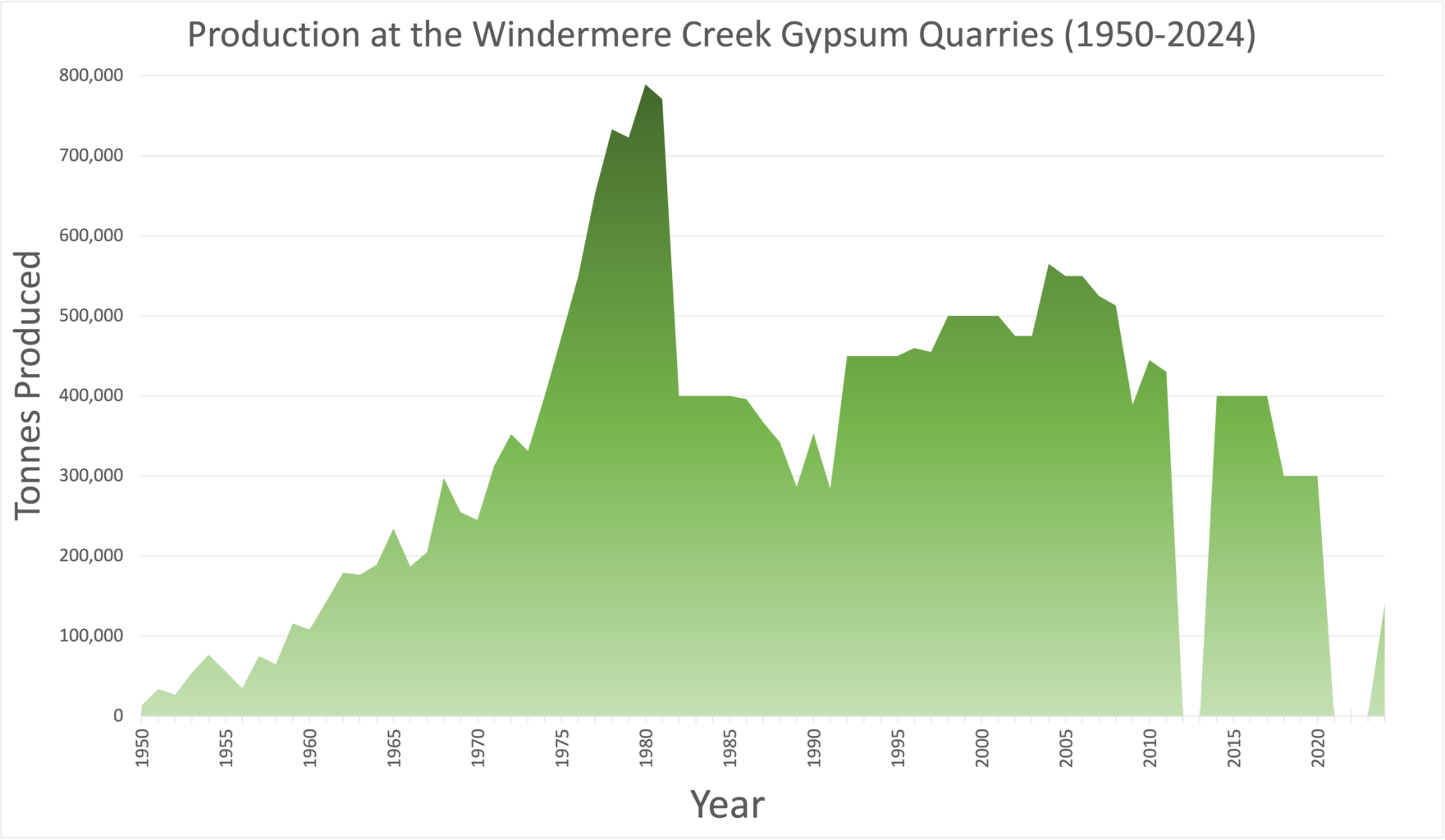
The height of production at the Windermere gypsum mine, fueled by strong building demand and shortages of drywall, was in 1980 when nearly 800,000 tonnes were produced.45 That year a new gypsum mine on the west coast of Mexico, combined with very low shipping rates and a downturn in the housing market, saw a depression in the gypsum market that lasted over a decade.46 For several decades now, since about 1990, the amount of gypsum produced from the quarries has stayed relatively steady at between 400,000 and 500,000 tonnes per year.
A more detailed graph of gypsum production in the Windermere Creek mines can be found below. There is some confusion in the sources between the amount of gypsum mined and the amount shipped in any given year: in cases where both figures are reported, the amount shipped has been used.
Quarries
Gypsum in the Windermere Valley has been mined from three groups of quarries. The first of these, the Windermere Creek quarries, were located around the original site of discovery on the north side of Windermere Creek. They were operational predominately from 1950-1982.
From 1983 until 2023, operations moved to the Elkhorn Quarries, located on the south side of Windermere Creek a few kilometers further upstream. This is what most valley residents will be familiar with as the gypsum mine. This move was undertaken during the ownership of Westroc Industries, so the extension of the mine road to this quarry (and thus the road in its entirety) is still known as the Westroc Mine Road. While major production from this quarry ceased in 2023, there is still material being mined here.
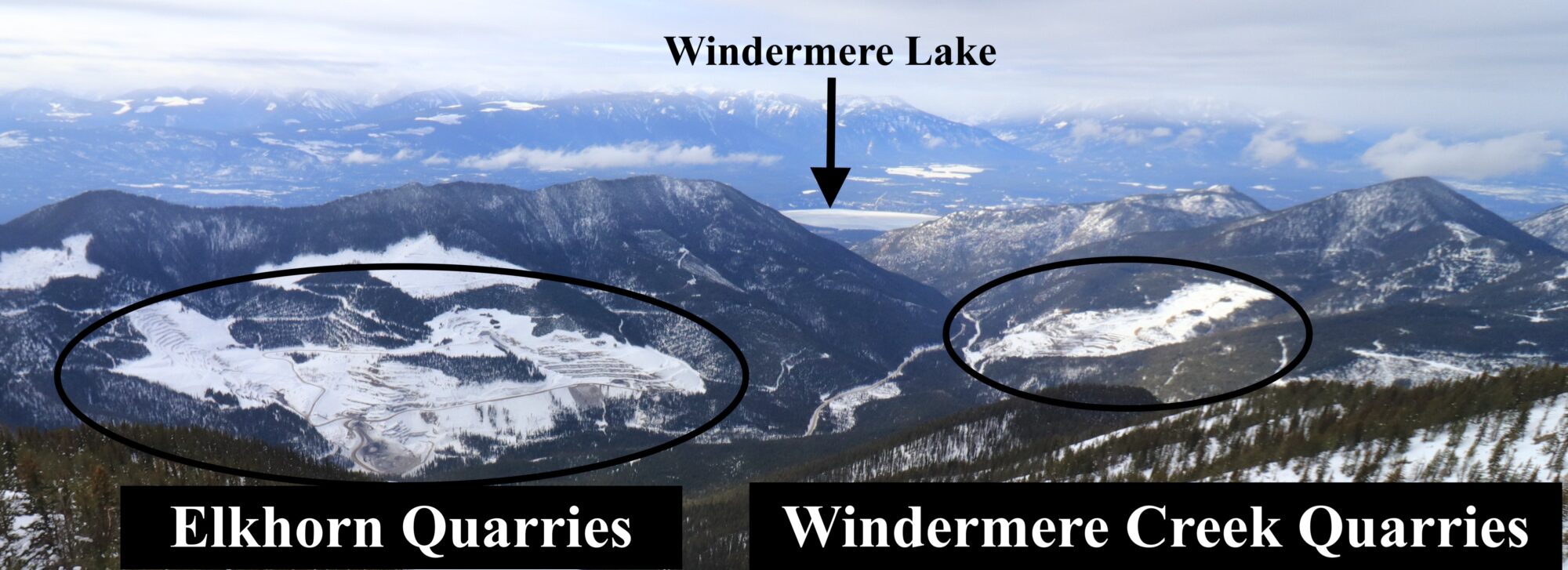
A third major move has occurred quite recently in 2023 to the Kootenay West property located on Kootenay River just east of Canal Flats. Full production at this site began at the end of last year, in October 2025.
The Windermere Creek Quarries
There were at least five quarries at the original site north of Windermere Creek, although I’ve been able to find very little information about the fourth and fifth, and over time they all seem to have bled over into one another.
No. 1 Quarry (1950-1958)
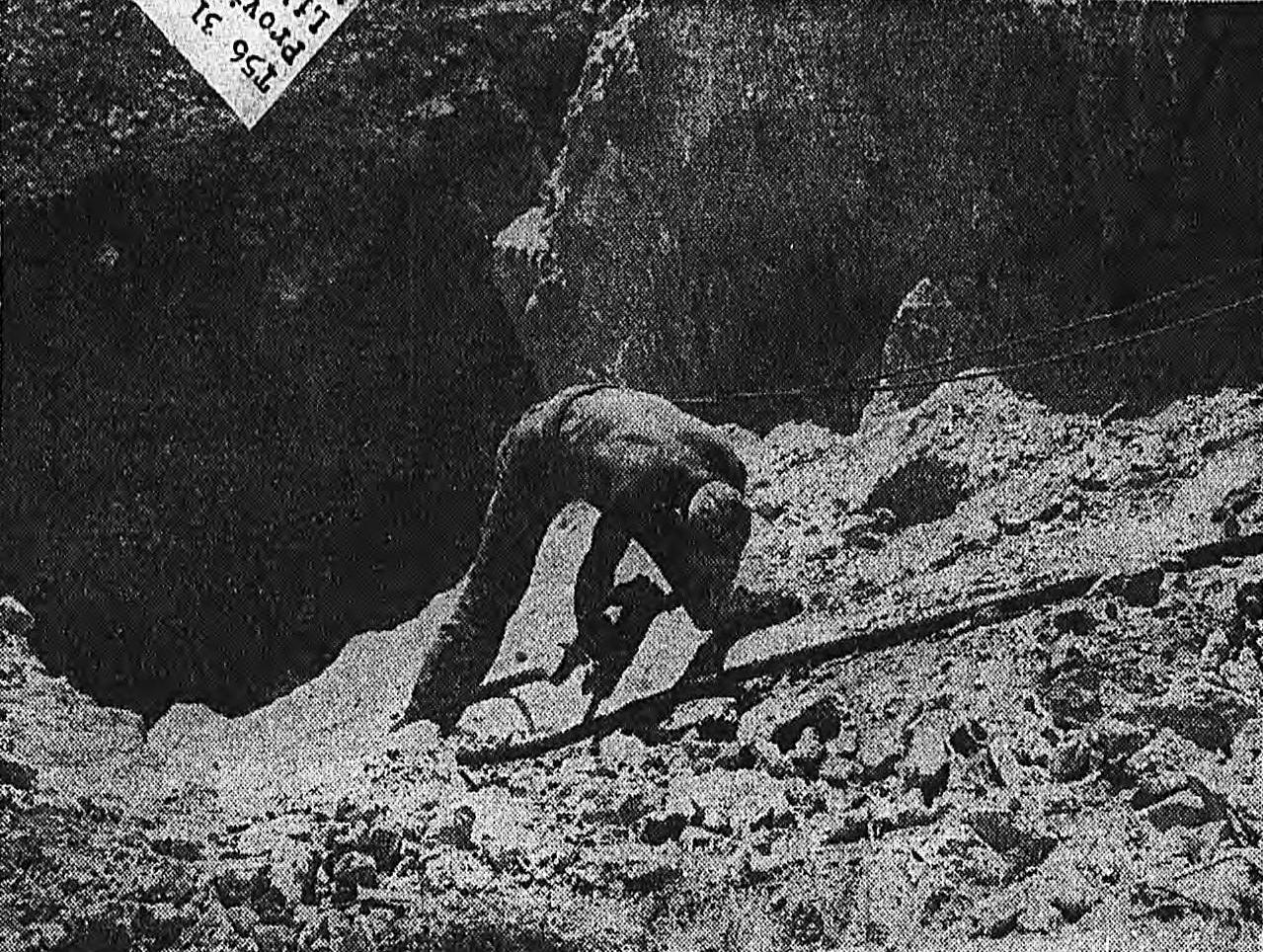
The first quarry got off to a rocky start. Work began there in spring 1950 and irregular shipments were made, but that summer masses of clay found scattered through the gypsum caused quality control problems. That layer of gypsum was abandoned and operations were moved to higher grade material located slightly further up the hill.47 Photos of early workings in the No. 1 Quarry, before operations were moved upwards, show drilling on a very steep face and what looks to be an entrance to some kind of underground workings. No written description of the latter has been found, although I have heard one account of work underground.48
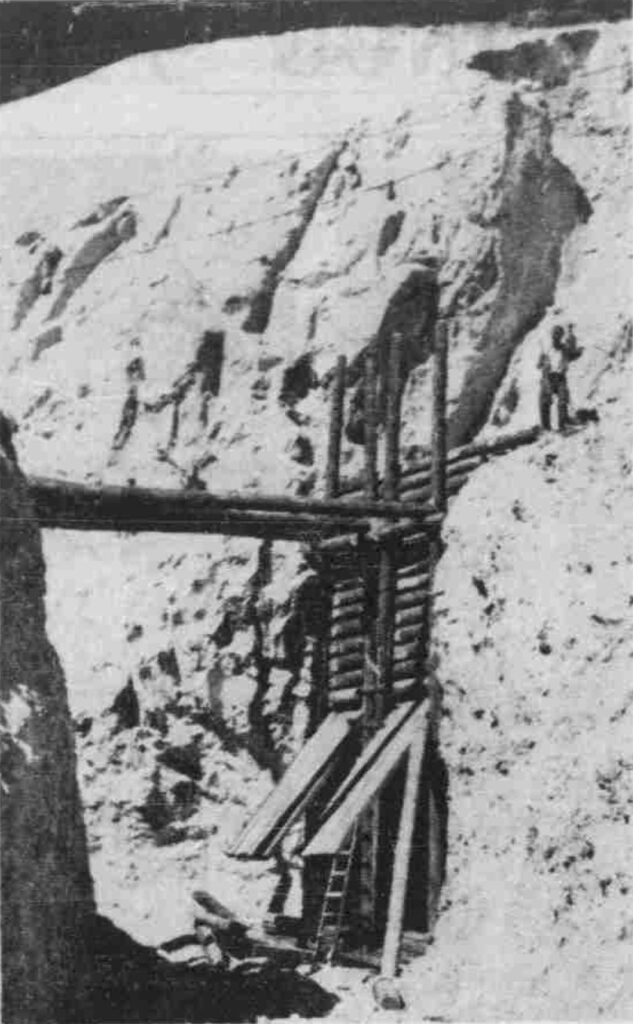
The Vancouver Daily Province, 8 April 1950, 35.
The new (slightly higher) No. 1 Quarry was located at an elevation of 4,000 feet (1,200 meters) on a steep, southwest slope on the hillside north of Windermere Creek.49 The earliest topographic map of this area (1966), based on data compiled between 1953 and 1962, shows the quarry at the intersection of the Blue Goose, Blue Hawk, and Blue Jay claims.
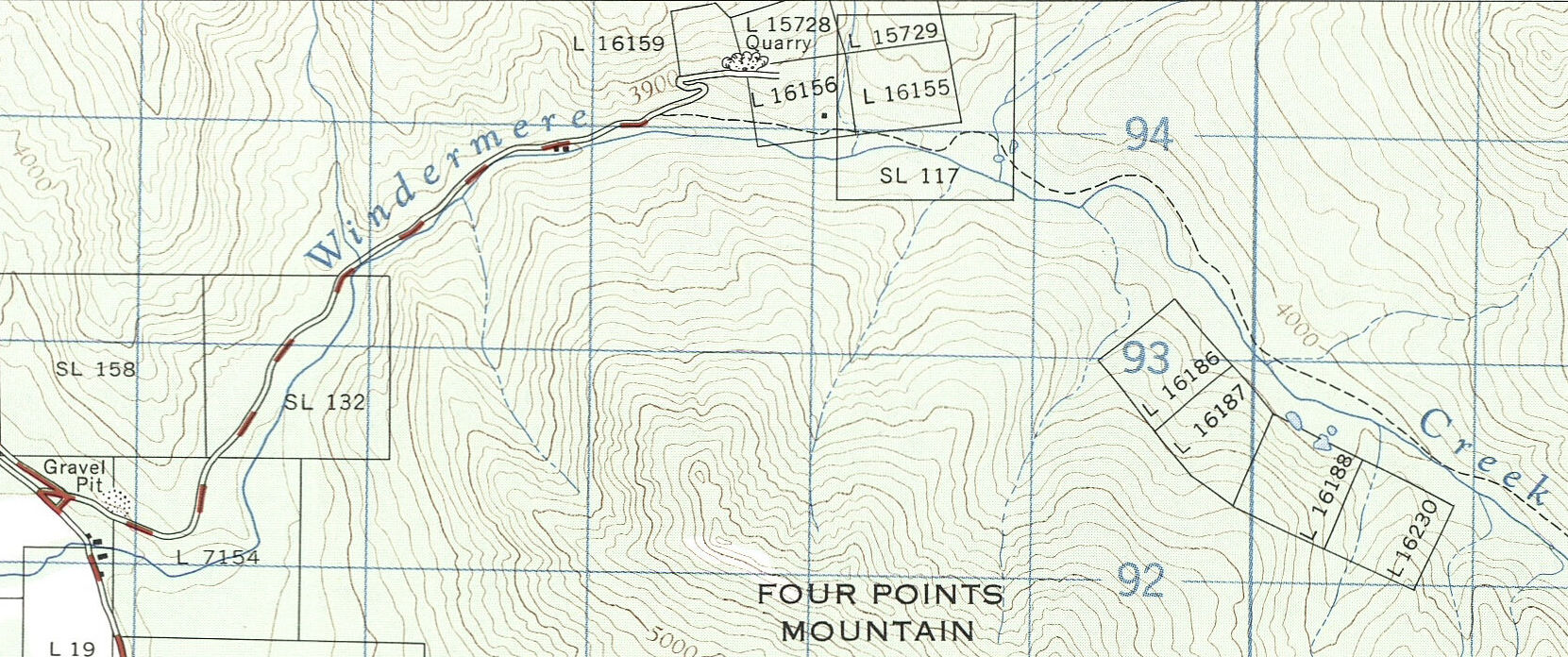
Ottawa: Dept. of Energy, Mines and Resources, Surveys and Mapping Branch, Fairmont Hot Springs (East) 82 J/5, Edition 1, 1966, https://www.canadiana.ca/view/qmma.19990
This first quarry was in operation from 1950 until October 1958, and photos from this period continue to show workers drilling on a very steep face. Gypsum was being removed in benches, but the walls of the quarry remained quite sharp and high: the face of it was around 110 feet (34 meters) high.50
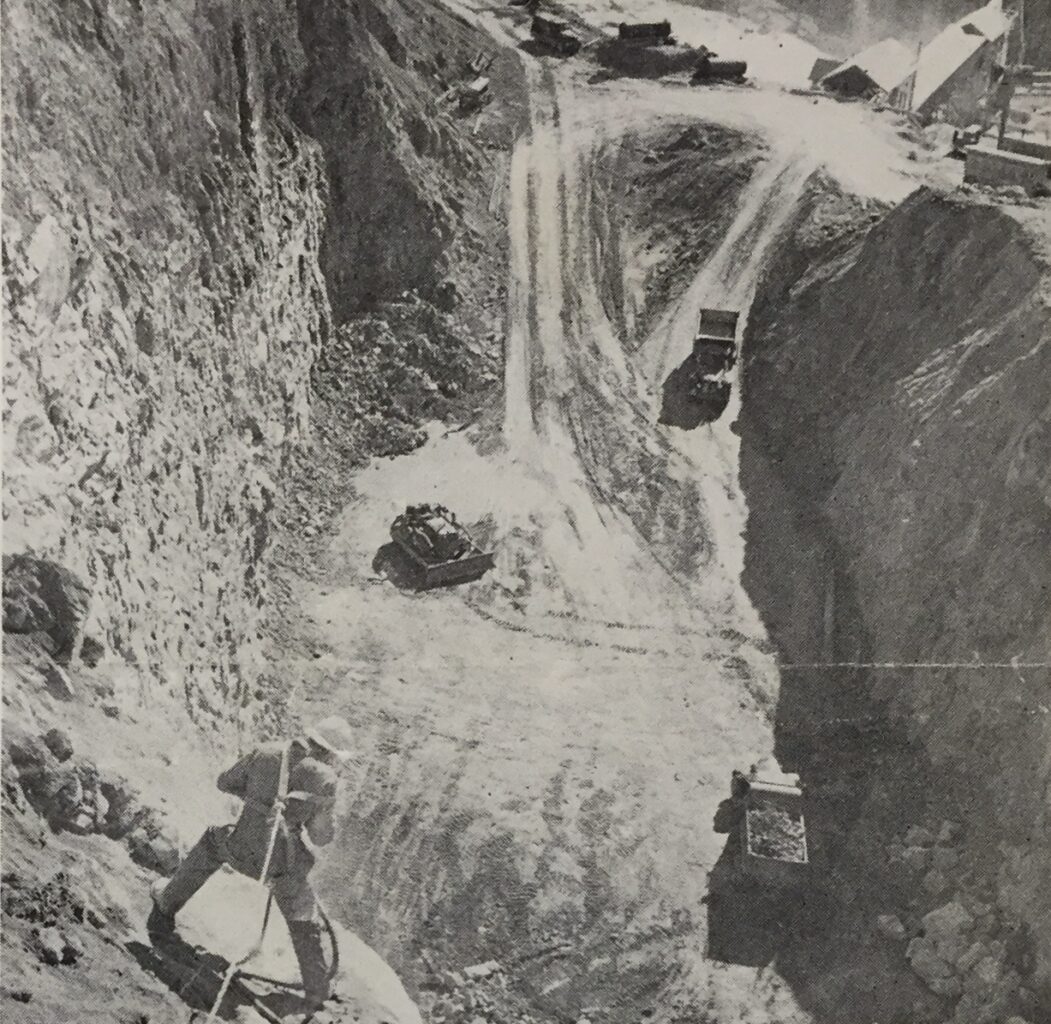
J.M. Cummings, Columbia Gypsum Products, Inc, “The Windermere Gypsum Deposit,” Western Miner and Oil Review, Vancouver, November 1953. In WVM Box G, File Gypsum mine.
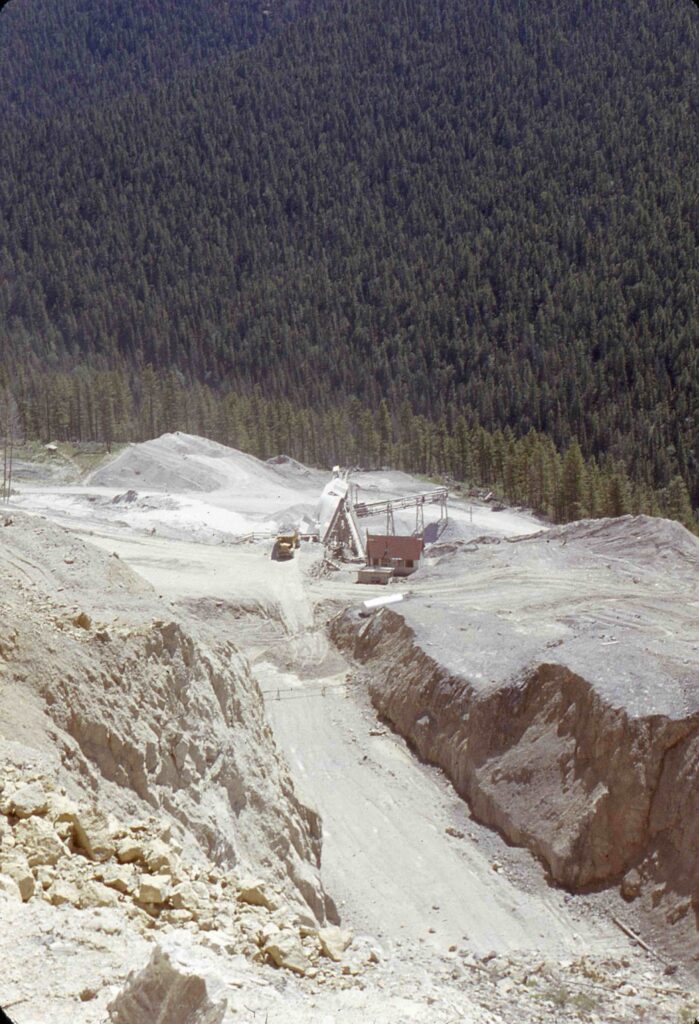
“Columbia Gyp. Original Quarry,” 1960, Dick Player File, British Columbia Property File, 507002.
No. 2 Quarry (1958-1964)
A new quarry, the No. 2 Quarry, was opened by Western Gypsum Products Ltd in 1958 about a half mile to the north of the No. 1 Quarry on the claims Blue Grouse and Blue Grouse 2, and at an elevation of 4,450 feet (1,350 meters).51 It was estimated to have reserves for three years of operation.
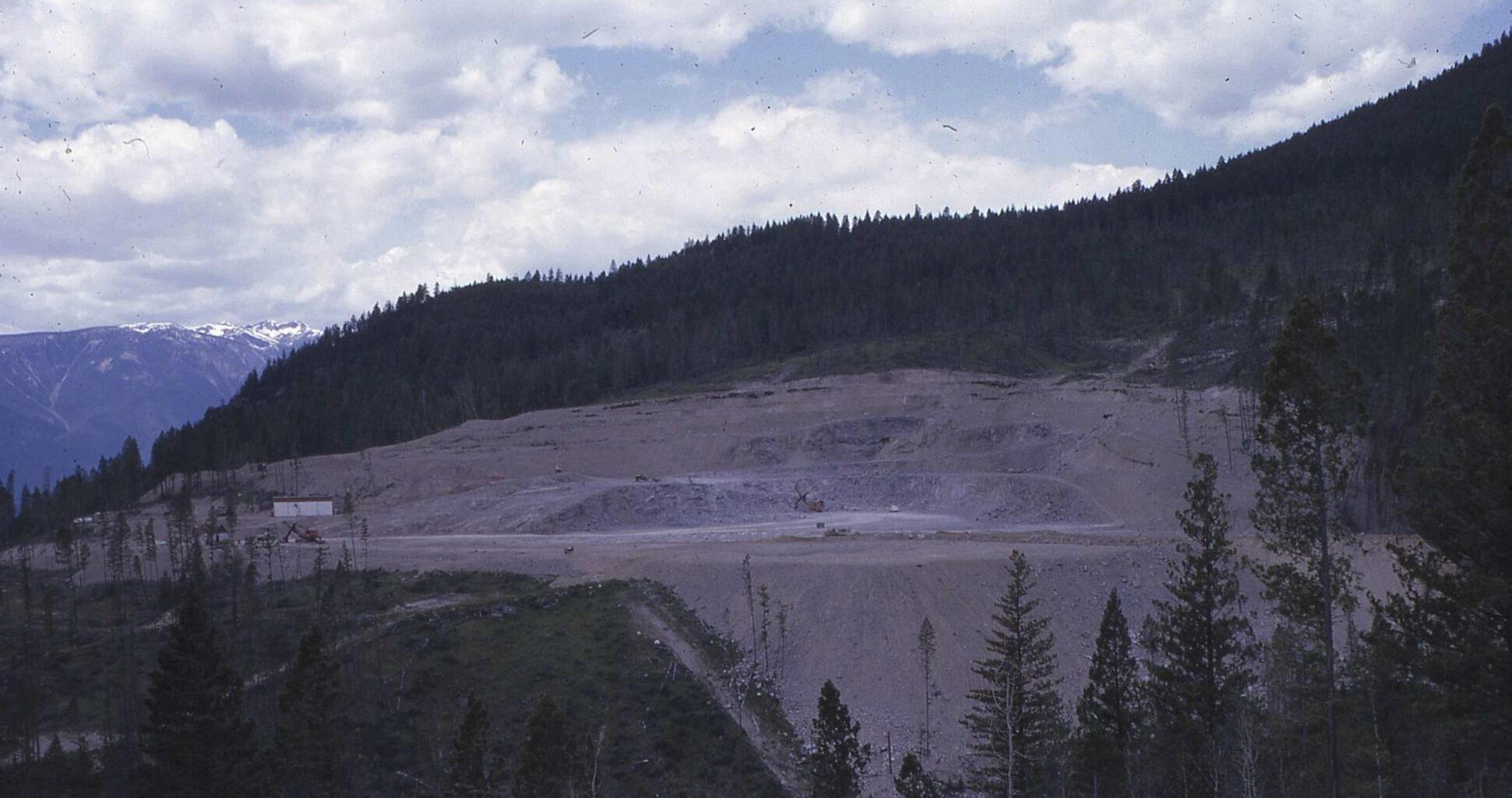
“Columbia Gypsum Gu. – 49MC62,” 1962, Dick Player File, British Columbia Property File, 507023.
This quarry was operated differently compared to the first. Rather than drill gypsum down in benches from the steep walls of a narrow pit, No. 2 Quarry was longer and broader with walls sloping back at a 45 degree angle. In 1959, the pit is described as being 400 feet long by 300 feet wide (120 by 90 meters).52 Gypsum was blasted and extracted in 15-foot (4.6 meter) tall benches, with loose rock then being loaded into trucks and, beginning in 1960, brought to be crushed on the property adjacent to the railway on the Shuswap Reserve.53 Production at No. 2 Quarry continued until fall 1964.
No. 3 Quarry (1964-1982)
Clearing for the No. 3 Quarry began in 1963, and it was opened for production in fall 1964.54 By 1965, all gypsum being produced was coming out of the No. 3 quarry.55 Once again gypsum was mined out in benches.
Sources are a bit unclear as to where the No. 3 Quarry was in relation to its predecessors, but judging from photos it was further up the hill. A series of photos over time indicates the large amount of material that was removed from this quarry. According to Jerry Kohorst, material mined towards the the top of the quarry was brought down to the stockpile at the base via a very long conveyor belt: this looks to be present in the second and third photos of this series.
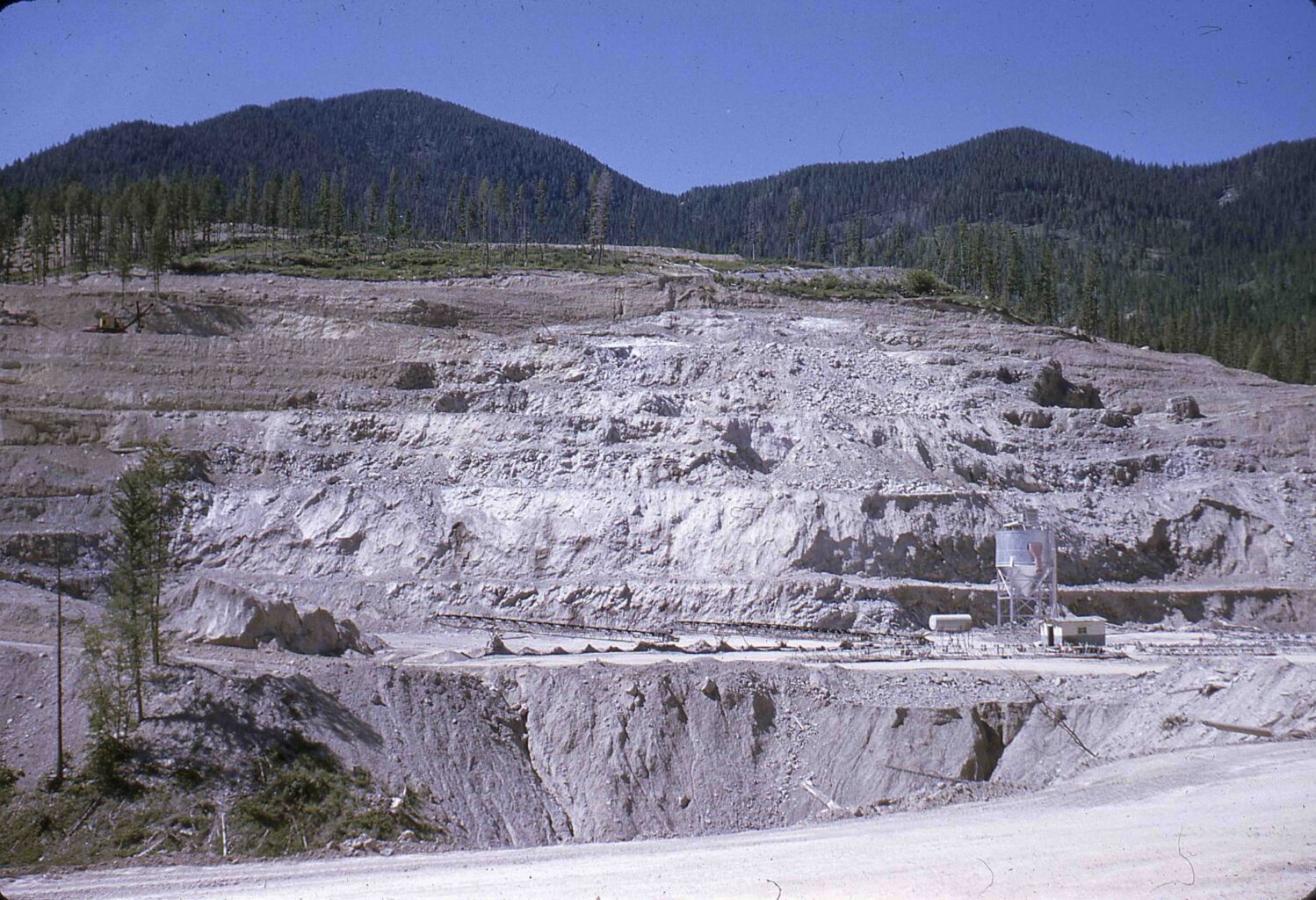
“Wind. Gyp. Quarry – 149MC67,” June 1967, Dick Player File, 507149, Property File, British Columbia.
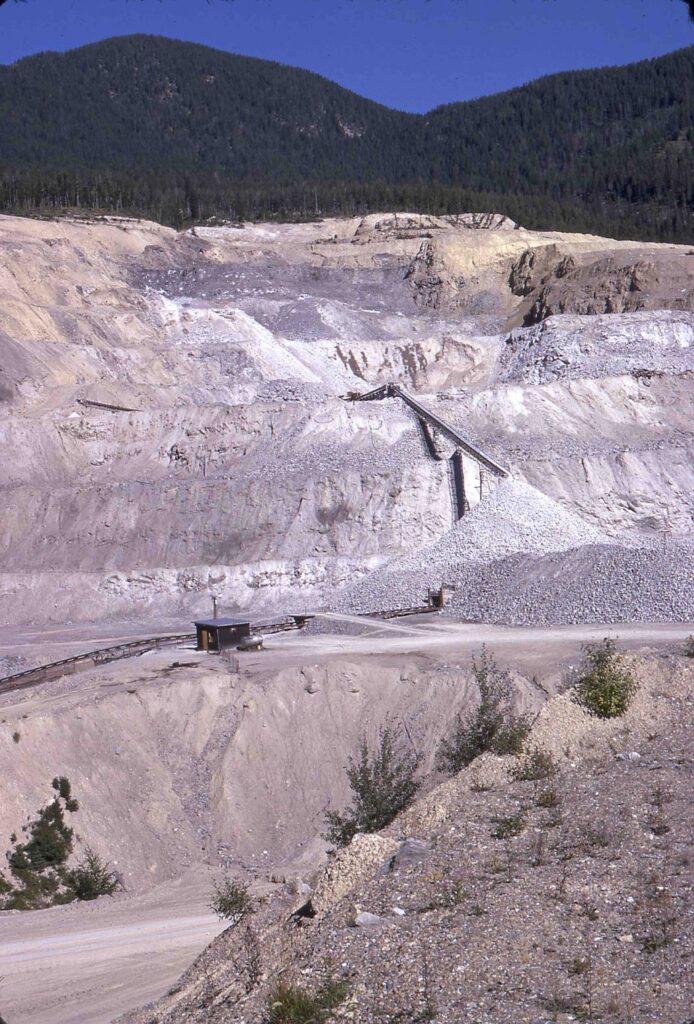
“Columbia Gypsum – 294MC74,” September 1974, Dick Player File, 507367, Property File, British Columbia.
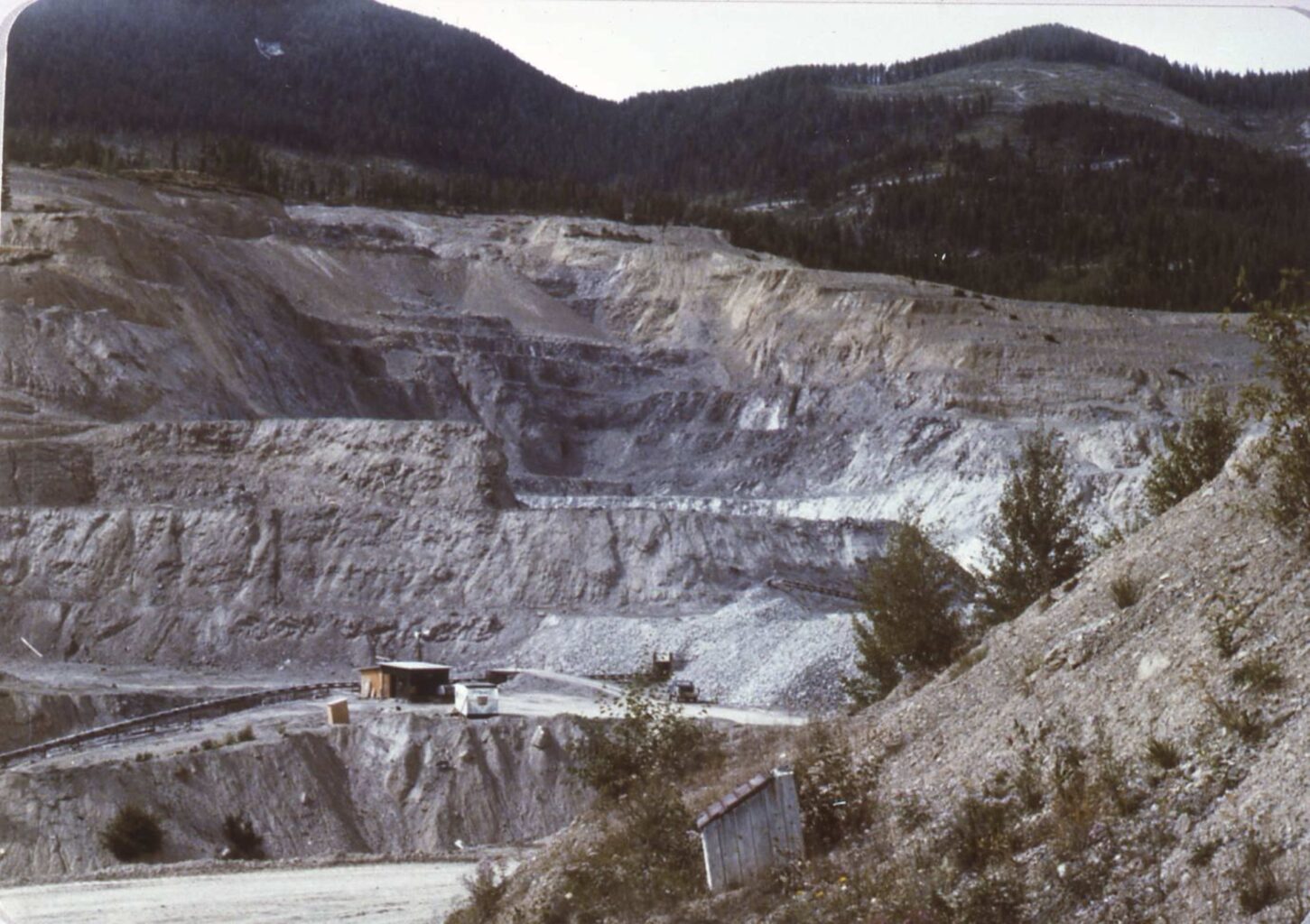
“Windermere Gypsum mine quarry,” 1981, Danny Hora, Dick Player File, 503376, Property File, British Columbia.
Operations at No. 3 Quarry ceased when major production was moved to the Elkhorn quarries in 1983.56 As of 1995 there was still some 400,000 tonnes of gypsum in the No. 3 Quarry suitable for cement. A provincial report on mines has gypsum production moving back to the No. 3 Quarry for a time in 1989/1990, although as all the crushing and processing equipment was then located at the Elkhorn Quarry this would have been quite a hassle.57 Jerry Kohorst, who worked at the mine, does not recall ever going back to the No. 3 Quarry.58
No 4. and No. 5 Quarries
Two additional quarries (the No. 4 and No. 5) were opened at an unknown date. The No. 4 was closed in 1982, but no further information about it has been located.59 The No. 5 quarry is noted only in a later (1995) report regarding past operations at the mine.60 Both were located on the north side of Windermere Creek, but unfortunately further detail is not available from the record reviewed.
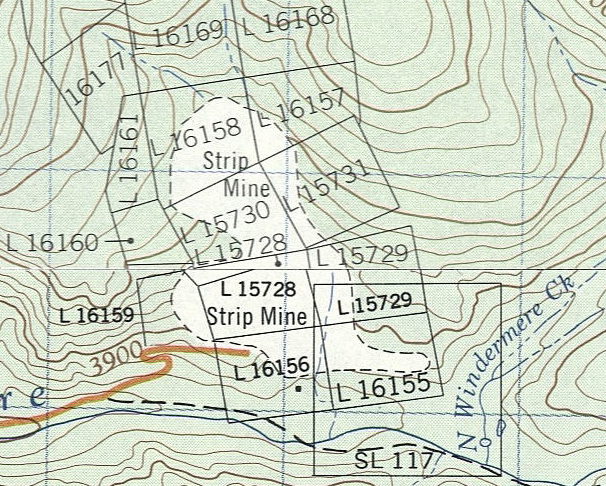
Ottawa: Dept. of Energy, Mines and Resources, Surveys and Mapping Branch: Fairmont Hot Springs, British Columbia 82 J/5 Edition 2, 1977, https://www.canadiana.ca/view/qmma.13269; Tangle Peak 82 J/12, Edition 2, 1977, https://www.canadiana.ca/view/qmma.13282.
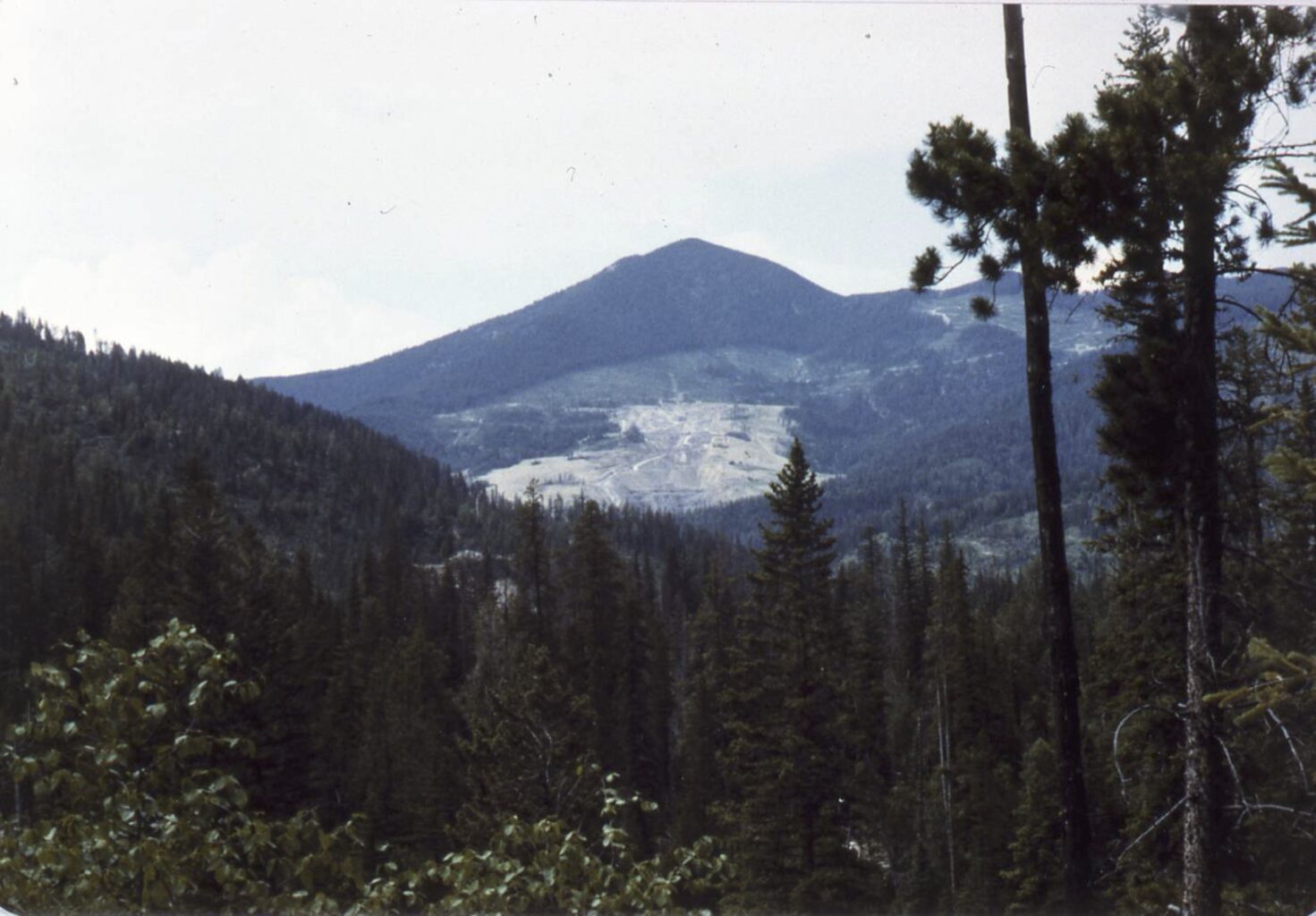
“Photo of Windermere gypsum mine,” 1981, Danny Hora, Dick Player File, 503375, Property File, British Columbia.
The Elkhorn Quarries
Located upstream on Windermere Creek, and about 3.5 kilometers south of the original operation, the central claims of the Elkhorn Group had been staked back in 1948.
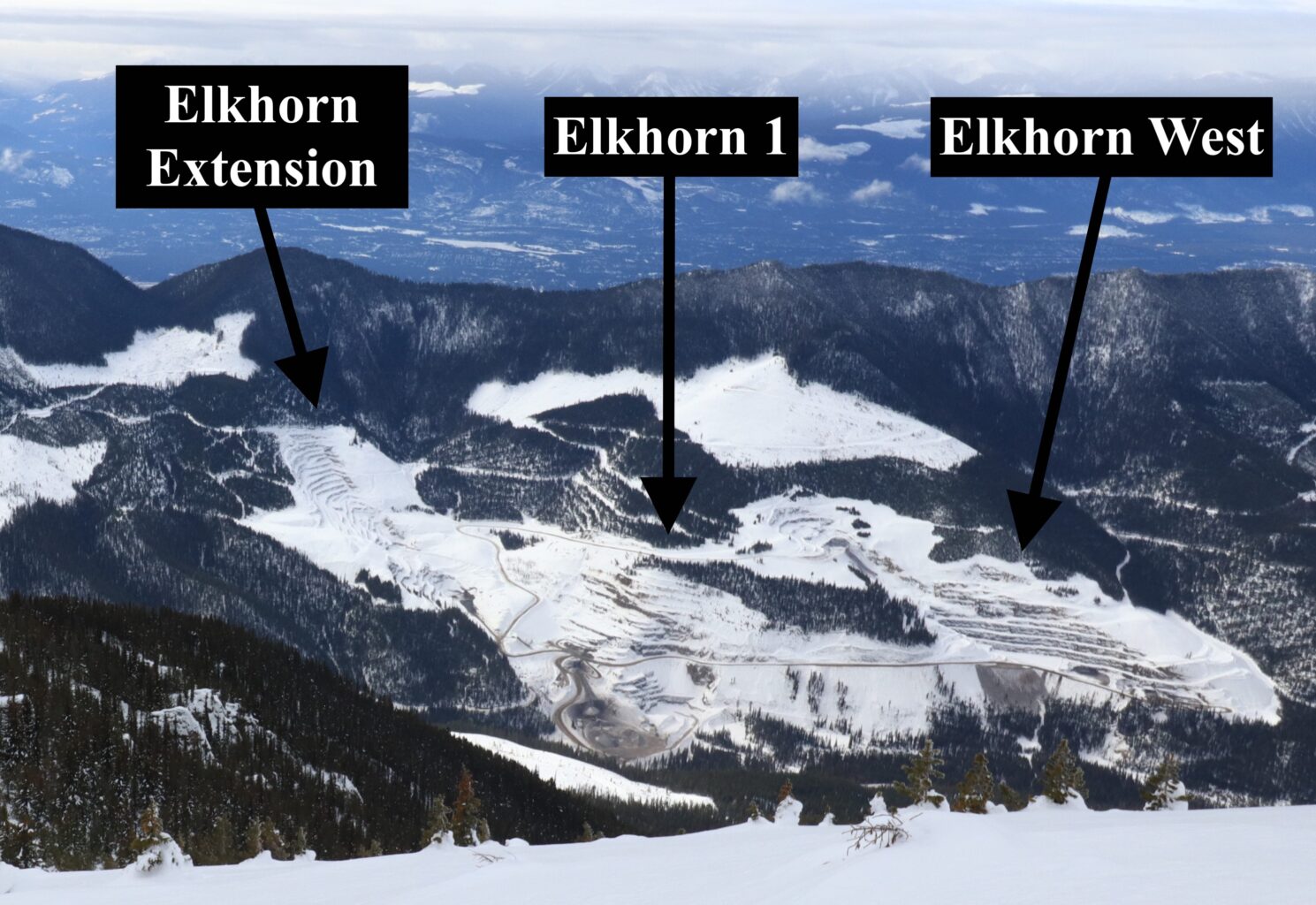
Elkhorn 1 (1983-c.1997)
Initial development work on the Elkhorn Group was concentrated on two of these original claims, the Elkhorn 1 and the Blue Bottle, as well as the adjacent Elkhorn 2 claim.61 The “Elkhorn 2” was used to refer to several slightly different properties over the years: in early years of exploration it was a small claim located to the southwest of the Elkhorn 1 and Blue Bottle.
A new road up Windermere Creek was put in to these claims in 1982, and the first year of production on the new Elkhorn quarry was in 1983.62 Operations at the Elkhorn continued at about 50% capacity until at least 1985.63
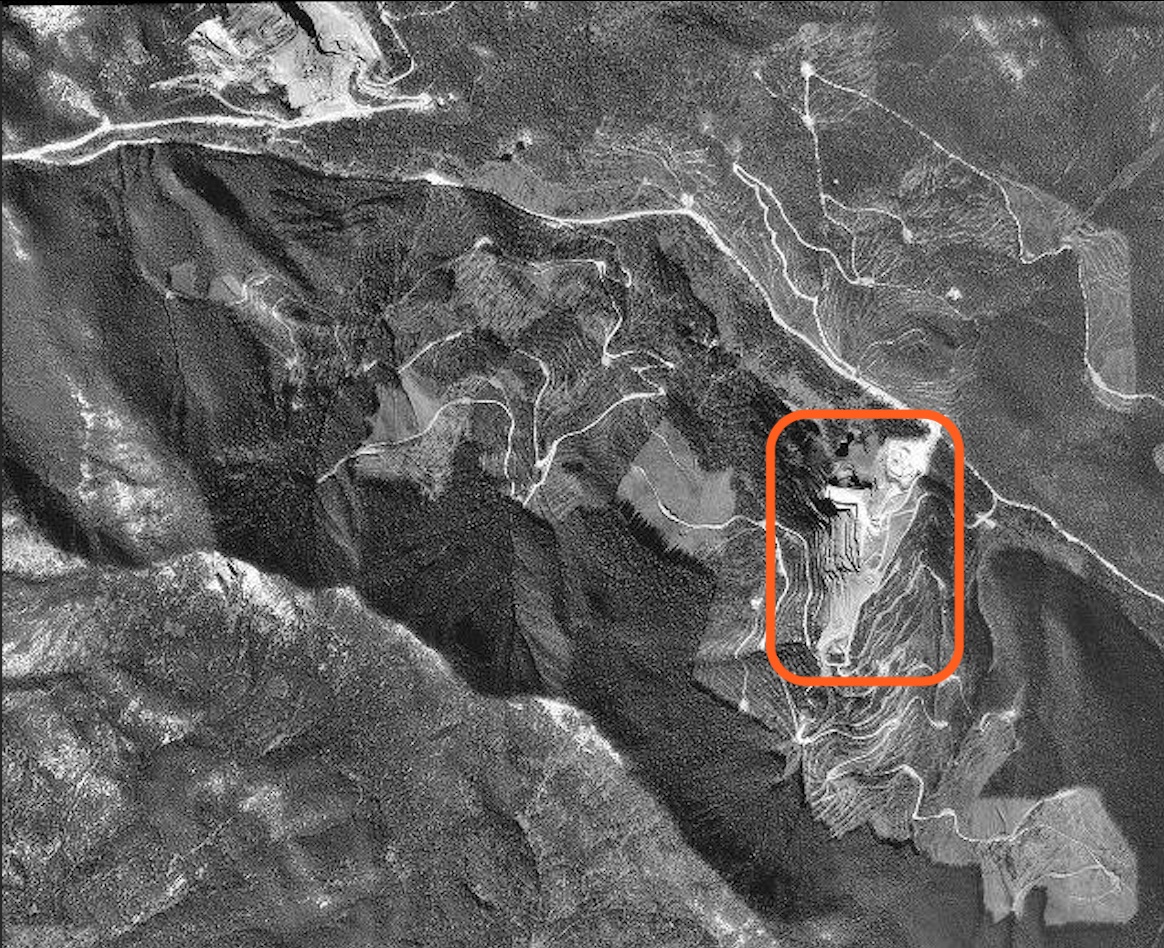
British Columbia: Maps & Orthos, Orthophotos (BCGS), 082j041 (1:20000), 1995 [cropped].
Elkhorn Extension (c.1997-2009)
In 1995, Westroc submitted a successful application to develop the Elkhorn Quarry Extension, also referred to as the Elkhorn 2, located just up the hill and to the southwest of the original Elkhorn.64 The extension included about 25 hectares of previously logged land (logging took place in 1970), and with an estimated five million tonnes of gypsum, it was predicted to extend the life of the Windermere mine for an additional seventeen years.65 Mining the Elkhorn Extension began in about 1997, and the bulk of gypsum came from here until 2009.66
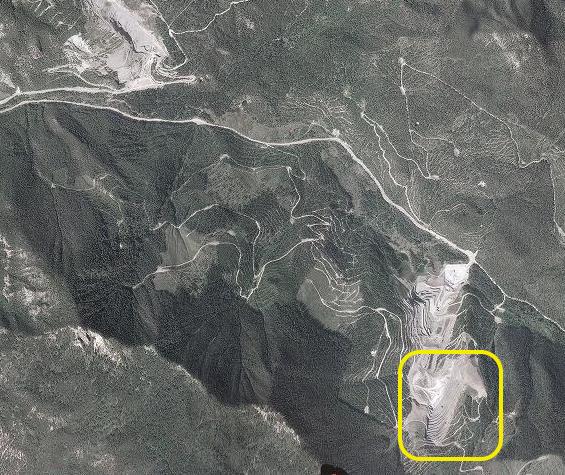
British Columbia: Maps & Orthos, Orthophotos (BCGS), 082j041 (1:20000), 2004 [cropped].
Elkhorn West (2009-2023)
Yet another extension of the Elkhorn quarry was made in the early 2000s with the Elkhorn West property. Drilling on this property in 2001 indicated an estimated 2.5 million tonnes of additional gypsum, further extending the life of the Elkhorn Quarries which were then expected to be exhausted and closed in 2005.67 The Elkhorn West Extension pit began production in 2009, and the following year most of the gypsum being mined was taken from here.68
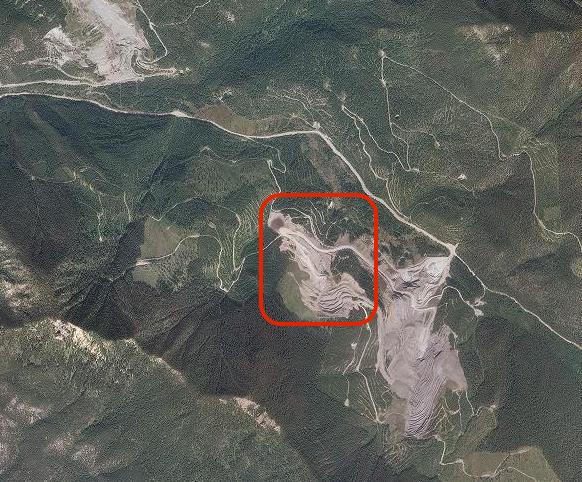
British Columbia: Maps & Orthos, Orthophotos (BCGS), 082j041 (1:20000), 2009 [cropped].
The Elkhorn West quarry extended the life of the Windermere quarries until 2023, in large part because, beginning in 2018, the holding company, CertainTeed, began to ship a mix of gypsum and anhydrite. Frequently found directly underneath deposits of gypsum and often considered a waste material, anhydrite is used in small quantities as a drying agent in plaster, paint, and varnish, and has been used as a source of sulphur to produce sulfuric acid.69 In this case, one of the drywall production plants had figured out how to combine gypsum with small quantities of anyhydrite.70 Shipping anhydrite extended the life of the Elkhorn Quarry even longer.
In 2024, low-grade gypsum was shipped from the Elkhorn quarries for cement production,71 and as of this writing CertainTeed plans to continue small shipments of gypsum from the Elkhorn quarries for agriculture and cement until about 2040 (another 15 years).72
Kootenay West (2023 – projected 2066)
Meanwhile, the centre of gypsum operations has moved to the Kootenay West property located northeast of Canal Flats. The existence of this property has been known for decades, with an initial block of claims being staked on the Kootenay River 6 to 8 miles (10 to 13 kilometers) north of Canal Flats in 1949 (these are marked in purple on the map at the top of the page).73
This property has seen extensive drilling and exploration for decades. Westroc was preparing to move over to the Kootenay West property in the early 2000s until the Elkhorn West deposit extended the life of that quarry and postponed the need.74 The move was delayed as long as possible in part due to increased shipping costs: the Canal Flats operations are further away from major purchasers (both by rail and truck).75
In March 2017, CertainTeed submitted an application to the Environmental Assessment Office for the Kootenay West Mine and received an environmental certificate the following January.76 The property is projected to have a 43 year lifespan with a production of 400,000 tonnes annually. On-site construction began in November 2019, and production of gypsum for wallboard transferred to the new property in 2023.77 Kootenay West entered full production at the end of last year (2025).78
Conclusion
Even if it’s now focused in a different location, gypsum production in the valley continues. It’s by far the longest mine to operate in the valley and, after over 75 years of production, it’s safe to say that the gypsum mine has been a fact of life for the majority of those living in the valley today. It’s a quiet but steady contributor to the valley economy: operations are largely forgotten until one drives up Windermere Creek (or now also up the Kootenay River), or has to pass a haul truck going through Kootenay Park. Nonetheless, it’s interesting to think of how many houses and fields, especially in Western Canada, that have a little bit of the Windermere Valley hidden inside of them.

Appreciate this kind of content?
Show your support!
Footnotes
- Rick Jarrett, “Application for a Mine Development Certificate for the Elkhorn Quarry Extension,” Westroc Industries Limited (Invermere), May 1995, 9, https://docs.openinfo.gov.bc.ca/Response_Package_EML-2023-31638.pdf. ↩︎
- Columbia Gypsum Products Ltd of Spokane purchased the property in spring 1948, and owned it until January 1955, when it was taken over by a Vancouver Group: the similarly named Columbia Gypsum Co Ltd. It was sold by Columbia Gypsum to Western Gypsum Products Ltd (Winnipeg) in June 1957. Western Gypsum Mines Ltd, based out of Clarkson, Ontario and itself a subsidiary of Western Gypsum Products Ltd, took over operation of the mine in 1966.
“BC Gypsum Mine Sold,” The Vancouver Daily Province, 2 April 1948, 32; “Gypsum Deposit Estimated Third Largest on Continent,” The Vancouver Daily Province, 6 April 1948, 24; “B.C. Men Take Over U.S. Firm,” The Vancouver Sun, 13 January 1955, 17; British Columbia. Sessional Papers. Lode Metals. Minister of Mines and Petroleum Resources Province of British Columbia Annual Report for the Year Ended December 31, 1955, 93, https://dx.doi.org/10.14288/1.0349116; “British Firm buys two B.C. gypsum plants,” The Province (Vancouver B.C.), 26 June 1957, 16; British Columbia. Sessional Papers. Lode Metals. Minister of Mines and Petroleum Resources Province of British Columbia Annual Report for the Year Ended December 31, 1966, 266, https://dx.doi.org/10.14288/1.0364476. ↩︎ - Western Gypsum Products seems to have been taken over by Westroc earlier than this, in about 1972, but reports are consistent that Westroc Industries took over operation of the mine in 1976. Westroc itself was originally incorporated in 1929, and had also become a subsidiary of BPB in June 1957. “Westroc Industries Limited,” Calgary Herald, 17 April 1972, 17; “The Advertising World,” The Globe and Mail, 5 July 1974, B4; “Major Mines, 1975, ” In: British Columbia. Sessional Papers. Minister of Mines and Petroleum Resources Annual Report, 1975, https://dx.doi.org/10.14288/1.0377959; British Columbia. Sessional Papers. Minister of Mines and Petroleum Resources Annual Report 1976, A 17, https://dx.doi.org/10.14288/1.0377942; Matthew S. Hedley, Mining in British Columbia (1975-1980), Vol 1: Mine Production, Province of British Columbia: Ministry of Energy, Mines, and Petroleum Resources, 44; “British Firm buys two B.C. gypsum plants,” The Province (Vancouver B.C.), 26 June 1957, 16. ↩︎
- “Schedule “A”: Notice of Certification of a Class Proceeding: September 8, 2003,” Calgary Herald, 17 September 2003, 52; David Grieve, “Kootenay Region,” In British Columbia. Ministry of Energy and Mines. Exploration and Mining in British Columbia 2004, January 2005, 70, https://cmscontent.nrs.gov.bc.ca/geoscience/publicationcatalogue/GeologyExplorationMining/BCGS_EXP2004.pdf. ↩︎
- The name of the operator of the mine changes from BPB Canada to CertainTeed in the 2006 and 2007 provincial reports. British Columbia Mines and Mineral Exploration: Overview 2005, British Columbia, Ministry of Energy, Mines, and Petroleum Resources, 4-5, https://cmscontent.nrs.gov.bc.ca/geoscience/PublicationCatalogue/InformationCircular/BCGS_IC2006-01.pdf; David Grieve, “Kootenay Region,” In Exploration and Mining in British Columbia 2007, British Columbia, Ministry of Energy, Mines, and Petroleum Resources – Mining and Minerals Division, January 2008, 79, https://cmscontent.nrs.gov.bc.ca/geoscience/publicationcatalogue/GeologyExplorationMining/BCGS_EXP2007.pdf ↩︎
- David Grieve, “Kootenay Region,” In British Columbia. Ministry of Energy, mines, and Petroleum Resources – Mining and Minerals Division, Exploration and Mining in British Columbia 2007, January 2008, 80, https://cmscontent.nrs.gov.bc.ca/geoscience/publicationcatalogue/GeologyExplorationMining/BCGS_EXP2007.pdf. ↩︎
- “Rich Gypsum Deposit Located by Accident,” The Cranbrook Courier, 3 March 1949. ↩︎
- “Rich Gypsum Deposit Located by Accident,” The Cranbrook Courier, 3 March 1949. ↩︎
- “Rich Gypsum Deposit Located by Accident,” The Cranbrook Courier, 3 March 1949. ↩︎
- “Indian Old-Timer Passes,” The Lake Windermere Valley Echo, 18 May 1961, 1. ↩︎
- British Columbia. Sessional Papers. Annual Report of the Minister of Mines for the Year Ended 31st December 1929, C229; British Columbia Geological Survey, MINFILE Record Summary, No 082LNW001, 24 July 1985 (last edit 10 September 2012), https://minfile.gov.bc.ca/summary.aspx?minfilno=082LNW001. ↩︎
- This property was reported in newspapers to cease production in 1928, although official reports suggest that it carried on at least through 1929. British Columbia. Sessional Papers. Annual Report of the Minister of Mines for the Year Ended 31st December 1926, A246, https://dx.doi.org/10.14288/1.0226082; Annual Report of the Minister of Mines for the Year Ended 31st December 1929, C299, https://dx.doi.org/10.14288/1.0300516; “Gypsum Property Mayook Shuts Down Indefinitely,” The Daily News (Nelson B.C.), 7 June 1928, 4, https://dx.doi.org/10.14288/1.0404255. ↩︎
- “Personalities of The Windermere,” The Lake Windermere Valley Echo, 28 June 1962, 2; Cameron had sold the Mayook gypsum deposits at the end of the 1920s, and in the mid 1940s mining activity on the Mayook deposits had resumed, “Mayook Quarry to Ship Gypsum,” Nelson Daily News, 9 May 1945, 7, https://dx.doi.org/10.14288/1.0417092. ↩︎
- E.C. Phillips and his wife, Mabel, were relatively recent arrivals in the valley, having come in 1946 from Vancouver/Williams Lake after heading a group of investors in purchasing the Elkhorn Ranch. “Real Estate Deals Continue in Windermere District,” Nelson Daily News, 8 April 1946, 5, https://dx.doi.org/10.14288/1.0417988. ↩︎
- Survey Plan of Lot 16155 Kootenay District (Blue Bird) et. al, Tube 41, Tray 13 – Kootenay, British Columbia: GATOR; “Locate Gypsum Claims in Tegart Pass Area,” [n.d.] Box “G” Mining in the Windermere District, File Gypsum Mine; “Gypsum Found at Windermere,” The Vancouver Daily Province, 13 September 1947, 43. ↩︎
- “Expect Gypsum at Windermere to Begin Operation Soon; Plans For Road Building Set in Motion,” Nelson Daily News, 6 May 1948, 1, https://dx.doi.org/10.14288/1.0423353. ↩︎
- British Columbia. Sessional Papers. Province of British Columbia Public Accounts Fiscal Year Ended 31st March 1949 Period from 1st April 1948 to 31st March 1949, EE 255, https://dx.doi.org/10.14288/1.0340933; British Columbia. Sessional Papers. Minister of Public Works Report for the Fiscal Year 1949-50, Q 94, https://dx.doi.org/10.14288/1.0342772. ↩︎
- “Find High Grade Gypsum in Windermere Area,” Nelson Daily News, 4 September 1947, 2, https://dx.doi.org/10.14288/1.0418216; “Gypsum Found at Windermere,” The Vancouver Daily Province, 13 September 1947, 43. ↩︎
- J.M. Cummings, Columbia Gypsum Products, Inc, “The Windermere Gypsum Deposit,” Western Miner and Oil Review, Vancouver, November 1953. In WVM Box G, File Gypsum mine ↩︎
- The company was registered as an Extra-Provincial Company in B.C. on 18 May 1948. “Companies Act,” No 3263A (Columbia Gypsum Products, Inc), The British Columbia Gazette, vol 88, no 21 (20 May 1948), 1418, https://archive.org/embed/governmentgazett88nogove_c9b8. ↩︎
- “Gypsum Deposit Estimated Third Largest on Continent,” The Vancouver Daily Province, 6 April 1948, 24; “Estimate 40 Million Ton Deposit of Gypsum in Windermere District,” Nelson Daily News, 23 April 1948, 1, https://dx.doi.org/10.14288/1.0423394 ↩︎
- British Columbia. Sessional Papers. Minister of Mines Province of British Columbia Annual Report for the Year Ended 31st December 1947, A214, https://dx.doi.org/10.14288/1.0340097; “BC Gypsum Mine Sold,” The Vancouver Daily Province, 2 April 1948, 32;
A permit for the Spokane factory was not applied for until July 1948: “Seek Permit to Build $600,000 Gypsum Factory,” Nelson Daily News, 30 July 1948, 1, https://dx.doi.org/10.14288/1.0423418. ↩︎ - “Columbia Gypsum Co. Plant Schedules Early Production,” Pit and Quarry, Vol 42, Iss 12 (June 1950), 48, https://archive.org/embed/sim_pit-quarry_1950-06_42_12; “”British Columbia,” Engineering and Mining Journal, Vol 151, Iss 6 (June 1950), 133, https://archive.org/embed/sim_engineering-and-mining-journal_1950-06_151_6 ↩︎
- British Columbia. Sessional Papers. Minister of Mines Province of British Columbia Annual Report for the Year Ended 31st December 1948, A 185, https://dx.doi.org/10.14288/1.0340719; British Columbia. Sessional Papers. Minister of Mines Province of British Columbia Annual Report for the Year Ended 31st December 1950, A221, https://dx.doi.org/10.14288/1.0342879. ↩︎
- British Columbia. Sessional Papers. Minister of Mines Province of British Columbia Annual Report for the Year Ended 31st December 1950, A221, https://dx.doi.org/10.14288/1.0342879 ↩︎
- “Windermere Gypsum Deposit Over Million tons, Company Estimates,” Nelson Daily News, 26 July 1948, 4, https://dx.doi.org/10.14288/1.0423448. ↩︎
- “Gypsum Deposit Estimated Third Largest on Continent,” The Vancouver Daily Province, 6 April 1948, 24; “Direct Men in Incorporation Windermere Gypsum Development,” Nelson Daily News, 7 April 1948, 5, https://dx.doi.org/10.14288/1.0423419. ↩︎
- British Columbia. Sessional Papers. Minister of Mines Province of British Columbia Annual Report for the Year Ended 31st December 1949, A255, https://dx.doi.org/10.14288/1.0342754. ↩︎
- Survey Plan of Lot 16230 Kootenay District (Elkhorn No. 1) et. al, Tube 27, Tray 6 – Kootenay, British Columbia: GATOR. ↩︎
- British Columbia. Sessional Papers. Minister of Mines Province of British Columbia Annual Report for the Year Ended 31st December 1949, A255, https://dx.doi.org/10.14288/1.0342754 ↩︎
- “Shipping from Windermere Gypsum Mine Expected to Start Shortly,” Nelson Daily News, 10 April 1950, 3, https://dx.doi.org/10.14288/1.0425903. ↩︎
- “Make First Gypsum Shipment from Windermere,” Nelson Daily News, 28 April 1950, 3, https://dx.doi.org/10.14288/1.0425532. ↩︎
- “Columbia Gypsum Co. Plant Schedules Early Production,” Pit and Quarry, Vol 42, Iss 12 (June 1950), 48, https://archive.org/embed/sim_pit-quarry_1950-06_42_12 ↩︎
- The difficulty of wet gypsum was described to me by Jerry Kohorst, who worked at the mine for 38 years. Interview with Jerry Kohorst by Alex Weller, 11 March 2026. ↩︎
- British Columbia. Sessional Papers. Minister of Mines Province of British Columbia Annual Report for the Year Ended 31st December 1950, A 223, https://dx.doi.org/10.14288/1.0342879 ↩︎
- British Columbia. Sessional Papers. Minister of Mines Province of British Columbia Annual Report for the Year Ended 31st December 1950, A 222, https://dx.doi.org/10.14288/1.0342879. ↩︎
- “Shipping from Windermere Gypsum Mine Expected to Start Shortly,” The Nelson Daily News, 10 April 1950, 3; “Cummings Family Leaves for Victoria,” The Cranbrook Courier, 18 February 1954, 10. ↩︎
- Interview with Jerry Kohorst by Alex Weller, 11 March 2026. ↩︎
- British Columbia. Sessional Papers. Lode Metals. Minister of Mines and Petroleum Resources Province of British Columbia Annual Report for the Year Ended December 31, 1960, 139-140, https://dx.doi.org/10.14288/1.0363082. ↩︎
- British Columbia. Sessional Papers. Lode Metals. Minister of Mines and Petroleum Resources Province of British Columbia Annual Report for the Year Ended December 31, 1966, 403, https://dx.doi.org/10.14288/1.0364476; British Columbia. Sessional Papers. Lode Metals. Minister of Mines and Petroleum Resources Province of British Columbia Annual Report for the Year Ended December 31, 1967, 308, https://dx.doi.org/10.14288/1.0367841. ↩︎
- Interview with Jerry Kohorst by Alex Weller, 11 March 2026; Rick Jarrett, “Application for a Mine Development Certificate for the Elkhorn Quarry Extension,” Westroc Industries Limited (Invermere), May 1995, 26, https://docs.openinfo.gov.bc.ca/Response_Package_EML-2023-31638.pdf. ↩︎
- J.M. Cummings, Columbia Gypsum Products, Inc, “The Windermere Gypsum Deposit,” Western Miner and Oil Review, Vancouver, November 1953. In WVM Box G, File Gypsum mine; Rick Jarrett, “Application for a Mine Development Certificate for the Elkhorn Quarry Extension,” Westroc Industries Limited (Invermere), May 1995, 27, https://docs.openinfo.gov.bc.ca/Response_Package_EML-2023-31638.pdf ↩︎
- Westroc Industries, which owned the mine from 1976-2003, also had drywall plants in Winnipeg, Mississauga, and Montreal. These would have been supplied with gypsum from elsewhere in Canada. “Westroc plans $13-million plant,” Calgary Herald, 15 May 1978, B10. ↩︎
- Rick Jarrett, “Application for a Mine Development Certificate for the Elkhorn Quarry Extension,” Westroc Industries Limited (Invermere), May 1995, 27, https://docs.openinfo.gov.bc.ca/Response_Package_EML-2023-31638.pdf ↩︎
- Rick Jarrett, “Application for a Mine Development Certificate for the Elkhorn Quarry Extension,” Westroc Industries Limited (Invermere), May 1995, 28, https://docs.openinfo.gov.bc.ca/Response_Package_EML-2023-31638.pdf
In this report the number is given as 870,000 tons: I assume from context (from figures given elsewhere in this document) that these were short tons and have converted accordingly.
This number also matches (somewhat) with a 1980 provincial report on production at the mine, which was for 886,351 tonnes produced, but this is specified as being between 1975-1980. As other (official) annual reports published confirm that production was much, much higher than this, the 1995 report number is used. Matthew S. Hedley, Mining in British Columbia (1975-1980), Vol 1: Mine Production, Province of British Columbia: Ministry of Energy, Mines, and Petroleum Resources, 44, https://cmscontent.nrs.gov.bc.ca/geoscience/publicationcatalogue/GeologyExplorationMining/BCGS_MIN1975-01.pdf ↩︎ - Rick Jarrett, “Application for a Mine Development Certificate for the Elkhorn Quarry Extension,” Westroc Industries Limited (Invermere), May 1995, 28, https://docs.openinfo.gov.bc.ca/Response_Package_EML-2023-31638.pdf ↩︎
- British Columbia. Sessional Papers. Minister of Mines Province of British Columbia Annual Report for the Year Ended 31st December 1950, A 222, https://dx.doi.org/10.14288/1.0342879. ↩︎
- This was second hand from Guy Messerli, who recalled being employed in the initial stages of development when there was underground work. No written record of underground mining has been located. ↩︎
- British Columbia. Sessional Papers. Minister of Mines Province of British Columbia Annual Report for the Year Ended 31st December 1950, A222, https://dx.doi.org/10.14288/1.0342879; J.M. Cummings, Columbia Gypsum Products, Inc, “The Windermere Gypsum Deposit,” Western Miner and Oil Review, Vancouver, November 1953. In WVM Box G, File Gypsum mine. ↩︎
- J.M. Cummings, Columbia Gypsum Products, Inc, “The Windermere Gypsum Deposit,” Western Miner and Oil Review, Vancouver, November 1953. In WVM Box G, File Gypsum mine. ↩︎
- British Columbia. Sessional Papers. Lode Metals. Minister of Mines and Petroleum Resources Province of British Columbia Annual Report for the Year Ended December 31, 1958, 89, https://dx.doi.org/10.14288/1.0356287; British Columbia. Sessional Papers. Lode Metals. Minister of Mines and Petroleum Resources Province of British Columbia Annual Report for the Year Ended December 31, 1962, 151, https://dx.doi.org/10.14288/1.0363466; British Columbia. Sessional Papers. Minister of Mines and Petroleum Resources Province of British Columbia Annual Report for the Year Ended December 31, 1963, 143, https://dx.doi.org/10.14288/1.0371066. ↩︎
- British Columbia. Sessional Papers. Lode Metals. Minister of Mines and Petroleum Resources Province of British Columbia Annual Report for the Year Ended December 31, 1959, 166, https://dx.doi.org/10.14288/1.0355803. ↩︎
- British Columbia. Sessional Papers. Lode Metals. Minister of Mines and Petroleum Resources Province of British Columbia Annual Report for the Year Ended December 31, 1961, 144, https://dx.doi.org/10.14288/1.0363348. ↩︎
- British Columbia. Sessional Papers. Minister of Mines and Petroleum Resources Province of British Columbia Annual Report for the Year Ended December 31, 1963, 143, https://dx.doi.org/10.14288/1.0371066; British Columbia. Sessional Papers. Lode Metals. Minister of Mines and Petroleum Resources Province of British Columbia Annual Report for the Year Ended December 31, 1964, 185, https://dx.doi.org/10.14288/1.0364030 ↩︎
- British Columbia. Sessional Papers. Lode Metals. Minister of Mines and Petroleum Resources Province of British Columbia Annual Report for the Year Ended December 31, 1965, 264, https://dx.doi.org/10.14288/1.0364185. ↩︎
- Province of British Columbia. Ministry of Energy, Mines and Petroleum Resources, Exploration in British Columbia 1990 (Mineral Resources Division: Geological Survey Branch, July 1991), 67, https://cmscontent.nrs.gov.bc.ca/geoscience/publicationcatalogue/GeologyExplorationMining/BCGS_EXP1990-00.pdf. ↩︎
- Province of British Columbia. Ministry of Energy, Mines and Petroleum Resources, Exploration in British Columbia 1990, Mineral Resources Division: Geological Survey Branch, July 1991, 67, https://cmscontent.nrs.gov.bc.ca/geoscience/publicationcatalogue/GeologyExplorationMining/BCGS_EXP1990-00.pdf. ↩︎
- Rick Jarrett, “Application for a Mine Development Certificate for the Elkhorn Quarry Extension,” Westroc Industries Limited (Invermere), May 1995, 9, https://docs.openinfo.gov.bc.ca/Response_Package_EML-2023-31638.pdf. ↩︎
- Rick Jarrett, “Application for a Mine Development Certificate for the Elkhorn Quarry Extension,” Westroc Industries Limited (Invermere), May 1995, 5, https://docs.openinfo.gov.bc.ca/Response_Package_EML-2023-31638.pdf ↩︎
- Rick Jarrett, “Application for a Mine Development Certificate for the Elkhorn Quarry Extension,” Westroc Industries Limited (Invermere), May 1995, https://docs.openinfo.gov.bc.ca/Response_Package_EML-2023-31638.pdf ↩︎
- G.G. Clow, “Assessment Report for Elkhorn #2 Mining Claim (Part of Elkhorn Group) Golden Mining Division,” 26 June 1980, Mineral Resources Branch Assessment Report (ARIS) No 8159, British Columbia Geological Survey, https://apps.nrs.gov.bc.ca/pub/aris/Report/08159.pdf/; G.G. Clow, “Assessment Report For Elkhorn 3 et. al (Part of Elkhorn Group), Golden Mining Division,” 12 March 1981, Mineral Resources Branch Assessment Report (ARIS) No 8974, British Columbia Geological Survey, https://apps.nrs.gov.bc.ca/pub/aris/Report/08974.pdf/. ↩︎
- Mining in British Columbia (1986-87), Province of British Columbia: Ministry of Energy, Mines, and Petroleum Resources, March 1990, 86, https://cmscontent.nrs.gov.bc.ca/geoscience/publicationcatalogue/GeologyExplorationMining/BCGS_MIN1986-01.pdf; Province of British Columbia. Mineral Resources Division Geological Branch. Exploration in British Columbia: 1983 (Victoria, 1986), xl, https://archive.org/embed/micro_IA40243209_1402 ↩︎
- Mining in British Columbia (1981-1985), Province of British Columbia: Ministry of Energy, Mines, and Petroleum Resources, August 1989, 60, https://cmscontent.nrs.gov.bc.ca/geoscience/publicationcatalogue/GeologyExplorationMining/BCGS_MIN1981-01.pdf ↩︎
- Rick Jarrett, “Application for a Mine Development Certificate for the Elkhorn Quarry Extension,” Westroc Industries Limited (Invermere), May 1995, https://docs.openinfo.gov.bc.ca/Response_Package_EML-2023-31638.pdf ↩︎
- Rick Jarrett, “Application for a Mine Development Certificate for the Elkhorn Quarry Extension,” Westroc Industries Limited (Invermere), May 1995, 31, 15, https://docs.openinfo.gov.bc.ca/Response_Package_EML-2023-31638.pdf ↩︎
- The written record is a bit sparse for this period. Development on the Elkhorn Extension has not begun in 1996, so I assume it began the following year. Production at Elkhorn West began in 2009 and the Elkhorn Extension was phased out through the following year.
British Columbia Mineral Exploration Review 1995 (Ministry of Energy, Mines and Petroleum Resources, British Columbia Geological Survey: Information Circular, 1996-1, 9, https://cmscontent.nrs.gov.bc.ca/geoscience/PublicationCatalogue/InformationCircular/BCGS_IC1996-01.pdf ; David Grieve, “Southeast Region,” In British Columbia. Ministry of Energy, Mines, and Petroleum Resources – Mining and Minerals Division, Exploration and Mining in British Columbia 2009, January 2010, 80, https://cmscontent.nrs.gov.bc.ca/geoscience/publicationcatalogue/GeologyExplorationMining/BCGS_EXP2009.pdf ↩︎ - Paul Wilton, Kootenay Region, In Exploration and Mining in British Columbia – 2000, Ministry of Energy and Mines, 2000, 51, https://cmscontent.nrs.gov.bc.ca/geoscience/publicationcatalogue/GeologyExplorationMining/BCGS_EXP2000-05.pdf; David A. Terry, “Kootenay Region,” In British Columbia. Ministry of Energy and Mines, Exploration and Mining in British Columbia – 2001, March 2002, 50-51, https://cmscontent.nrs.gov.bc.ca/geoscience/publicationcatalogue/GeologyExplorationMining/BCGS_EXP2001.pdf ↩︎
- Kirk Hancock et. al, British Columbia Mines & Mineral Exploration Overview 2010, Ministry of Forests, Mines and Lands and Ministry of Natural Resource Operations, 10, https://cmscontent.nrs.gov.bc.ca/geoscience/PublicationCatalogue/InformationCircular/BCGS_IC2011-01.pdf; Jay Fredericks et. al, British Columbia Mines & Exploration Overview 2009, Ministry of Energy, Mines and Petroleum Resources, 8, https://cmscontent.nrs.gov.bc.ca/geoscience/PublicationCatalogue/InformationCircular/BCGS_IC2010-01.pdf) ↩︎
- Hobart M. King, “Anhydrite,” Geology.com, accessed 15 January 2026, https://geology.com/minerals/anhydrite.shtml ↩︎
- Interview with Jerry Kohorst by Alex Weller, 11 March 2026. ↩︎
- Clarke, G., Northcote, B.K, Corcoran, N.L., Pothorin C., Heidarian, H., and Hancock, K., 2025. Exploration and Mining in British Columbia, 2024: A summary. In: Provincial Overview of Exploration and Mining in British Columbia, 2024, British Columbia Ministry of Mining and Critical Minerals, British Columbia Geological Survey Information Circular 2025-01, pp. 10, https://minedocs.com/29/Overview-Exploration-Mining-BC-2024.pdf ↩︎
- “Saint-Gobain Canada announces completion of construction of its CertainTeed Kootenay West Gypsum Mine in British Columbia,” 14 October 2025, Press release form Saint-Gobain: North America, https://www.saint-gobain-northamerica.com/pressrelease/saint-gobain-canada-announces-completion-construction-its-certainteed-kootenay-west-gypsum-mine-british-columbia ↩︎
- British Columbia. Sessional Papers. Minister of Mines Province of British Columbia Annual Report for the Year Ended 31st December 1949, A255, https://dx.doi.org/10.14288/1.0342754 ↩︎
- GJ Simandl et al, Industrial minerals in British Columbia – 2003, British Columbia. Ministry of Energy and Mines, GeoFile 2003-15, 6, https://www.researchgate.net/publication/242729851_INDUSTRIALMINERALS#pf6 ↩︎
- Interview with Jerry Kohorst by Alex Weller, 11 March 2026 ↩︎
- Clarke, G., Northcote, B., Katay, F., and DeGrace, J.R., “Exploration and Mining in British Columbia, 2017: A summary,” In: Provincial Overview of Exploration and Mining in British Columbia, 2017, (British Columbia Ministry of Energy, Mines and Petroleum Resources, British Columbia Geological Survey Information Circular: 2018-1), 15, 18, https://minedocs.com/17/FiresideMinerals_AR_2017.pdf; British Columbia Environmental Assessment Office, Environmental Assessment for Kootenay West Mine, EPIC database (accessed 15 January 2026), https://projects.eao.gov.bc.ca/p/588511ceaaecd9001b825fa5/application. ↩︎
- “Saint-Gobain Canada announces completion of construction of its CertainTeed Kootenay West Gypsum Mine in British Columbia,” 14 October 2025, Press release form Saint-Gobain: North America, https://www.saint-gobain-northamerica.com/pressrelease/saint-gobain-canada-announces-completion-construction-its-certainteed-kootenay-west-gypsum-mine-british-columbia ; Kirk Hancock, “Exploration and mining in the Southeast Region, British Columbia,” In: Provincial Overview of Exploration and Mining in British Columbia, 2022, (British Columbia Ministry of Energy, Mines and Low Carbon Innovation: British Columbia Geological Survey, Information Circular, January 2023), 119-120, https://cmscontent.nrs.gov.bc.ca/geoscience/PublicationCatalogue/InformationCircular/BCGS_IC2023-01-05.pdf ; Clarke, G., Northcote, B.K, Corcoran, N.L., Pothorin C., Heidarian, H., and Hancock, K., 2025. “Exploration and Mining in British Columbia, 2024: A summary,” In: Provincial Overview of Exploration and Mining in British Columbia, 2024, British Columbia Ministry of Mining and Critical Minerals, British Columbia Geological Survey Information Circular 2025-01, 10, https://minedocs.com/29/Overview-Exploration-Mining-BC-2024.pdf ↩︎
- “Saint-Gobain Canada announces completion of construction of its CertainTeed Kootenay West Gypsum Mine in British Columbia,” 14 October 2025, Press release form Saint-Gobain: North America, https://www.saint-gobain-northamerica.com/pressrelease/saint-gobain-canada-announces-completion-construction-its-certainteed-kootenay-west-gypsum-mine-british-columbia ↩︎
Leave a Reply